
Wear Resistant Steel Plate Grades Ranked for Impact and Abrasion: NM400, NM450, NM500, NM550, NM600 and Mn13
Quick answer: Ranked by fit to the dominant wear mode rather than by hardness number, the practical shortlist of wear resistant steel plate grades runs NM400 for general wear duty, NM450 as the balanced upgrade, NM500 for high-abrasion conditions where replacement downtime is expensive, NM550 for heavy sliding abrasion, and NM600 for extreme abrasive wear. Mn13 sits in a separate class: it is an austenitic high manganese plate that work-hardens under heavy impact instead of relying on quench-and-temper hardness.
This ranking is written for buyers who are past the research stage. It assumes the wearing component has already been identified, a replacement cycle is being observed, and the remaining question is which grade to standardise on — and which grade would simply be money spent that the application never returns. Every designation, hardness statement and application below is traceable to documented grade information or to first-party supply data from BGT Steel Plate (Jiangyin Baoguantao Import & Export Co., Ltd.), a Chinese supplier of wear resistant steel plates and high strength steel plates established in 2013.
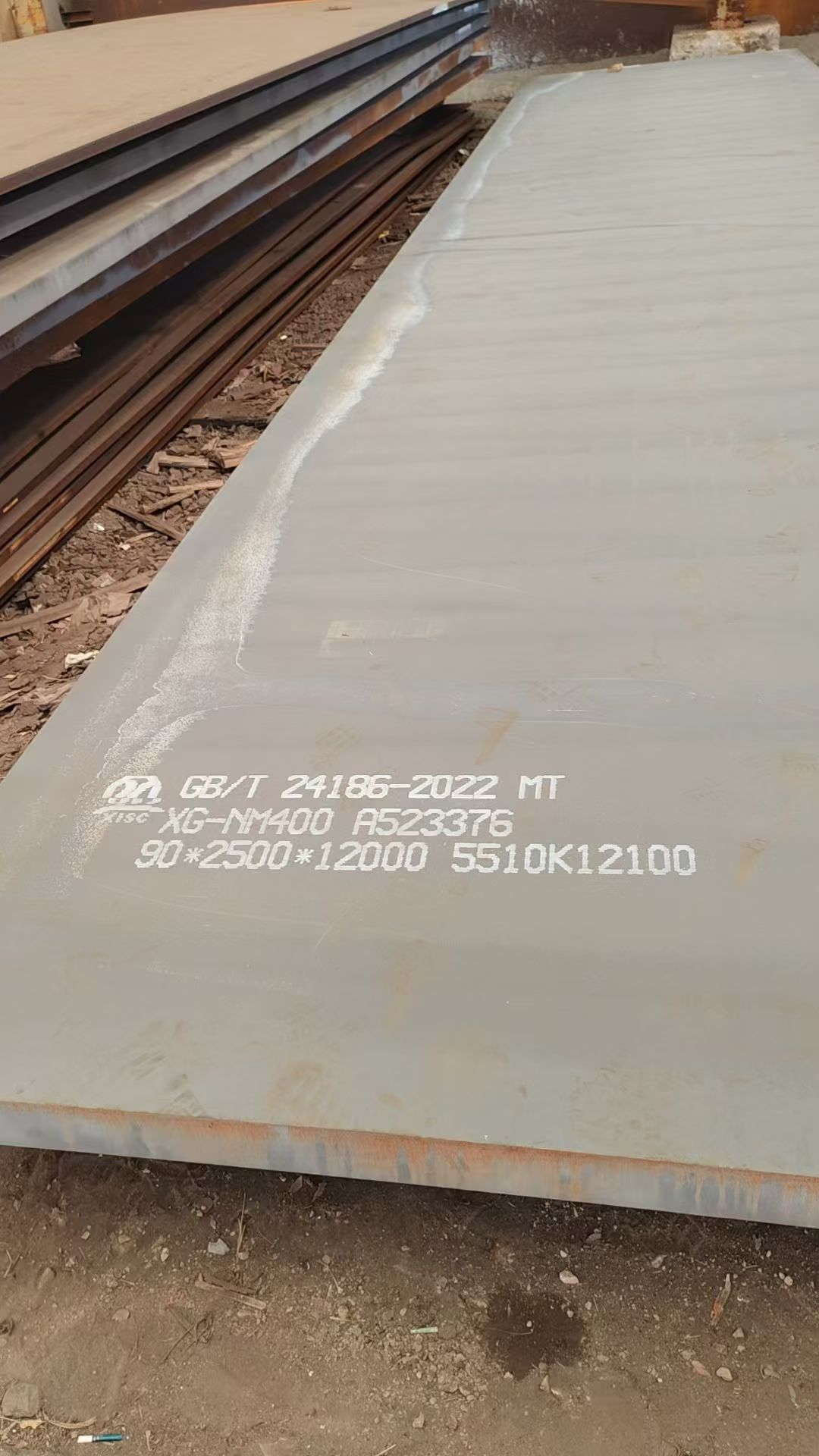
NM400 wear resistant steel plate — the baseline grade on this ranked shortlist, used for excavator buckets, dump truck beds and crusher liners.
The Buyer Problem: Grade Escalation Is Easy to Buy and Hard to Justify
Wear plate procurement tends to fail in one of two directions. Under-specifying produces a liner that wears through ahead of the planned maintenance window, which shows up as unplanned downtime and repeated plate replacement. Over-specifying produces a plate that costs more per tonne, is harder to cut, bend and weld, and can behave worse under impact than the cheaper grade it replaced.
The confusion usually comes from ranking grades on a single number. NM400, NM450 and NM500 are common Chinese commercial grades with hardness levels typically between HBW 350 and 500 as a group, so hardness alone does not explain why two plates in the same band behave differently on the same chute. What actually separates them is the wear mode — sliding abrasion, gouging abrasion, or repeated heavy impact — and how the material responds to it.
A second, harder-to-detect problem is substitution. Wear-resistant steel priced significantly below the market average is highly likely to involve ordinary steel passed off as wear-resistant steel, hardness that fails to meet the stated grade, or falsified material certificates. A common practice is supplying ordinary carbon steel such as Q235 or Q355 that has merely been surface quenched or carburized. That material lacks core toughness and is prone to fracturing under impact, which turns a wear problem into a safety problem.
Industry Background: Why Grade Fit Now Drives Wear Plate Procurement
Global wear resistant steel plate demand reached USD 1.756 billion in 2024 and is projected to grow to USD 3.055 billion by 2035, according to Market Research Future. China's wear resistant steel market for 2025 is projected at USD 0.817 billion (Business Research Insights). Mining accounted for a 45.67% share of wear resistant steel plate demand in 2025, which is why grade-selection arguments in this category are usually mining arguments first and everything else second.
Documentation matters as much as metallurgy at this stage of procurement. Flat-rolled products of other alloy steel, of a width of 600 mm or more, not further worked than hot-rolled, are classified under HS code 722540 — so buyers comparing landed cost across origins should expect quotations and customs paperwork to reference that heading.
The commercial reality behind the ranking is an escalation ladder. NM400, NM450 and NM500 occupy the mainstream band. NM550 and NM600 step into higher surface hardness, with NM600 at approximately 600 HBW. Mn13 works from an entirely different mechanism. Treating that ladder as a simple upgrade path — always buying the hardest plate the budget allows — is the most common and most expensive mistake in this category.
The Ranked Shortlist: Six Grades by Application Fit
The ranking below is ordered by documented application fit at the lowest cost that reliably removes the failure mode. It is deliberately not ordered by hardness, and Mn13 is placed as a separate class because its mechanism is not comparable to the NM series.
Inclusion criteria used for this ranking
- A documented grade designation that can be traced to a mill test certificate — NM-series grades referenced to Chinese national standard GB/T 24186, and Mn13 (X12Mn12) high manganese steel.
- A documented wear mechanism: martensitic quench-and-temper hardness for the NM series, dynamic work-hardening for Mn13.
- Documented intended applications, so a buyer can match grade to equipment rather than to a specification sheet.
- Verified supply availability in the required size range: thickness 3–150 mm, width 600–3950 mm, lengths including 2438 mm, 5800 mm, 6000 mm, 6096 mm, 12000 mm and 12200 mm, with customized sizes accepted.
- A clear over-specification penalty, so the ranking can be read downwards as well as upwards.
Rank 1 — NM400: The General Wear Duty Baseline
NM400 is the industry standard for general wear applications and the grade that most projects should start from. Documented applications include dump truck boxes, excavator buckets, hoppers, crusher liners and construction and mining equipment in general. Its advantage is not peak hardness but balance: wear resistance, good formability and good weldability in the same plate, with a typical acceptance band for NM400/AR400 cited around 360–440 HBW in hardness testing guidance.
The economics are well documented. Against Q235 carbon steel, NM400-class material delivers much better wear resistance and roughly 3–4 times longer service life on a mining dump truck cargo body, at approximately 30% higher material cost, with less frequent plate replacement as the return. That trade is the whole argument for the grade: a modest cost premium buys a multiple of service life and less equipment downtime.
NM400 is also the reference point for international comparison. As a mature grade complying with GB/T 24186, it is positioned by Chinese suppliers as an economical Hardox-equivalent wear resistant steel plate alternative, and both materials share similar fabrication characteristics — NM400 supports standard cutting and cold bending, and with proper welding procedures it meets the fabrication demands of complex structural components. NM400 is the wrong choice when the dominant mode is severe sliding abrasion and the cost of stopping the line to replace a liner is far higher than the plate itself.
Rank 2 — NM450: The Balanced Upgrade
NM450 exists for one reason: NM400 that wears too fast. Under comparable conditions, NM450 wear life is approximately 15–20% longer than NM400 while the plate maintains cold-formability and weldability, and it is suited to medium-to-high wear conditions. Documented applications include chutes, loader cutting edges, mining machinery and garbage compactor components.

NM450 wear resistant steel plate, 4 × 2000 × 8600 mm — the intermediate step when NM400 wear life is too short but processing conditions still require formability and weldability.
NM450 ranks above NM400 in application fit for moderate-to-severe abrasion specifically, not as a general replacement. Where impact dominates and abrasion is secondary, the higher grade adds cost without adding life.
Rank 3 — NM500: High Abrasion Where Downtime Is Expensive
NM500 is selected for high-abrasion conditions — concrete mixers, mining chutes, scrapers, ore chutes and hoppers — where component replacement downtime is costly and extra surface hardness is required. It carries significantly higher hardness and longer service life than NM400, but also higher material cost and slightly poorer formability, with a correspondingly higher cracking risk if fabrication practice is careless.
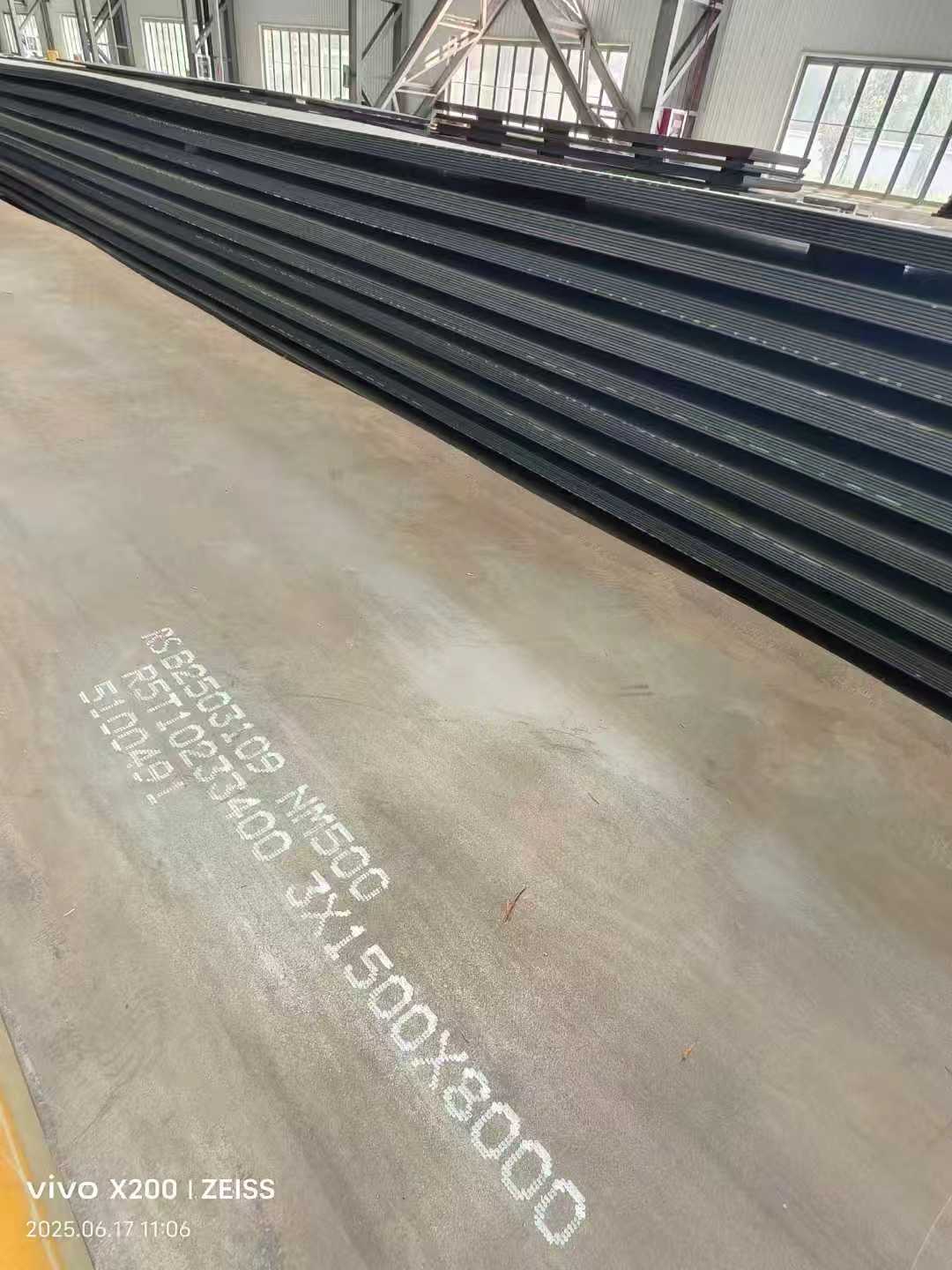
NM500 abrasion resistant steel plate, 3 × 1500 mm — specified for mining chute and hopper lining where replacement downtime is the dominant cost.
The comparison between the two adjacent grades is instructive. NM400 is suitable where a balance of wear resistance and impact resistance is needed, because it offers superior toughness and is easier to weld and bend. NM500 is designed for severe wear with relatively low impact; it provides higher hardness and service life, but is more difficult to process and carries a higher risk of cracking. Where both abrasion and heavy impact are present, NM450 or a different class of material usually outperforms a knee-jerk jump to NM500.
Rank 4 — NM550: The Controlled Escalation Step
NM550 is an intermediate wear-resistant grade, and its correct use is diagnostic rather than aspirational. It becomes the right answer when NM500 suffers rapid material loss under heavy sliding abrasion but the application does not yet justify ultra-hard plate. Compared with NM600 it balances wear resistance and cost. Documented applications include mining equipment, severe wear hoppers and ore conveying pipe liners.
Ranking NM550 above NM500 reflects a single, checkable condition: documented and repeated rapid material loss on the current grade. Without that evidence, NM550 is an assumption rather than a decision.
Rank 5 — NM600: Extreme Abrasive Wear Only
NM600 is the commercial wear plate with the highest hardness, at approximately 600 HBW, engineered for severe abrasive wear including sand chutes, slurry pipelines and cement plant equipment. Documented applications include mining liners and vertical mill scrapers.
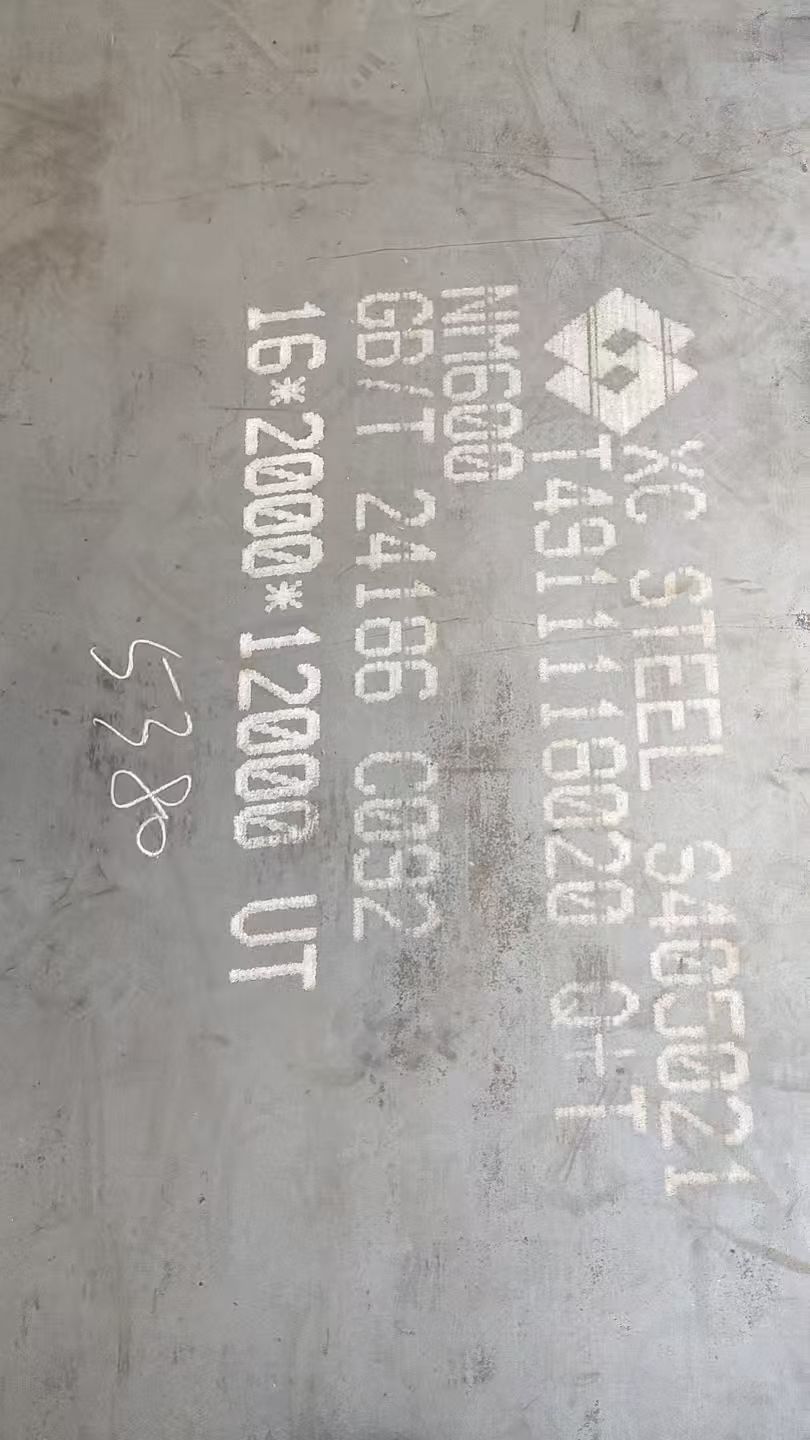
NM600 wear resistant steel plate at approximately 600 HBW — reserved for extreme abrasive wear in sand chutes, slurry pipelines and cement plant equipment.
The ranking position comes with the strongest warning of the six. Cold forming and welding NM600 are difficult and must follow strict technical specifications. It also carries the highest material cost and the toughest processing requirements in the range. The rule that follows from that is simple: do not over-specify NM600 if NM550 can satisfy the wear demand.
Rank 6, Separate Class — Mn13: Heavy Impact Work-Hardening
Mn13 is not an upgrade of anything. It is an austenitic high manganese steel (X12Mn12) that dynamically work-hardens under heavy impact and compressive stress: the surface hardness rises from roughly 200 HBW to over 500 HBW in service, while the substrate remains tough and ductile. It is designed for heavy shock and impact wear — railway frogs and turnout crossings, jaw crusher plates, cone crusher mantles, shredder components and shot-blasting machine liners.
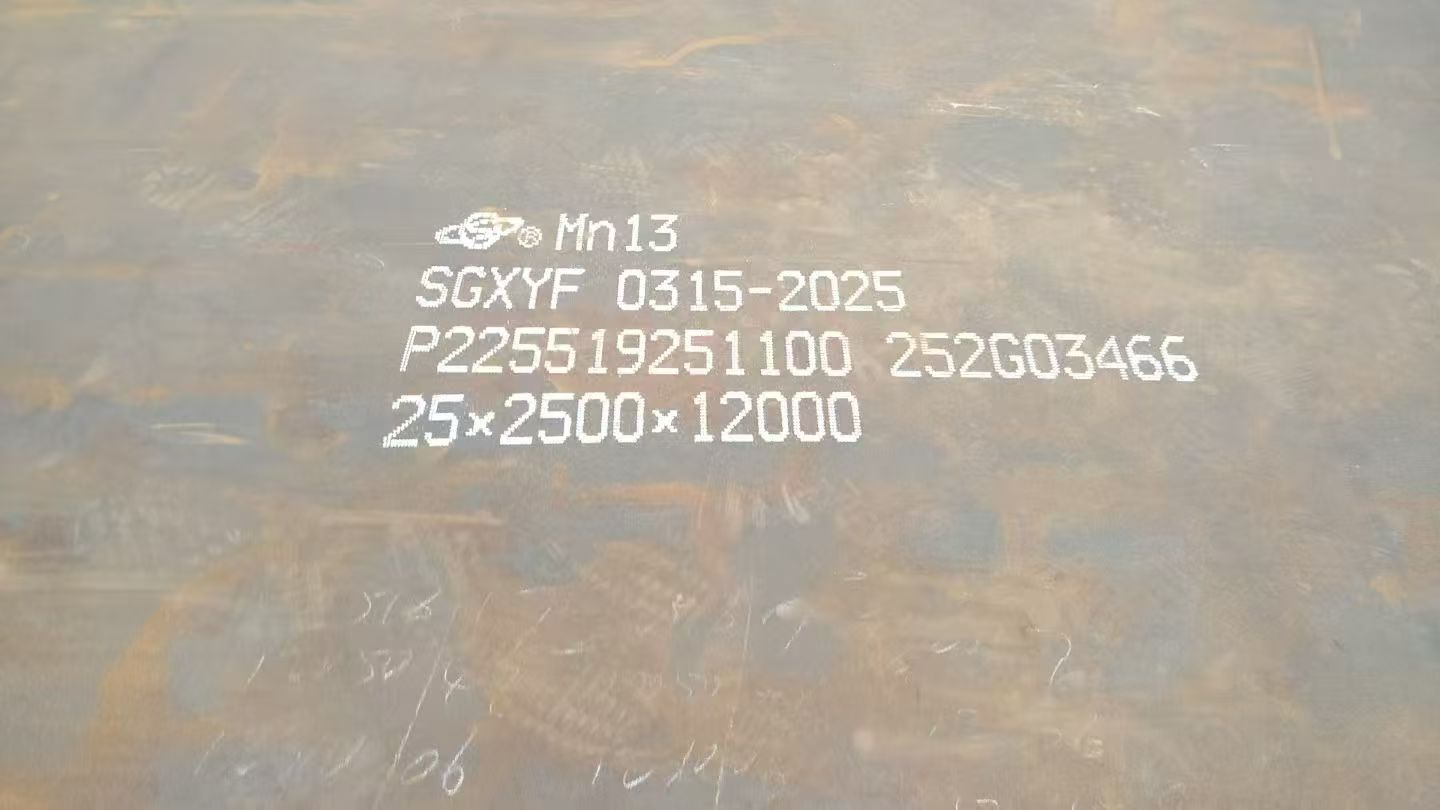
Mn13 high manganese steel plate, 25 mm — a work-hardening surface layer over a tough core, for repeated heavy impact rather than pure abrasion.
The boundary condition is explicit: Mn13 is not suitable for pure abrasive wear without impact. Considering cost, Mn13 delivers the best service-life value in impact-intensive working conditions, while the NM series is more economical for low-impact abrasive wear. That single sentence resolves most Mn13 versus NM series arguments before they start.
Not Ranked: Q690 High Strength Steel Plate Is a Structural Grade
Q690 high strength steel plate is frequently quoted alongside wear grades and should not be ranked with them. Q690D is a structural steel with a minimum yield strength of 690 MPa and tensile strength of 770–940 MPa for thickness up to 50 mm under GB/T 16270-2009, and it is applied in coal mining and construction equipment where load-bearing capacity governs. Its role is structural strength and weight reduction, not surface wear resistance. For long-term reliable performance in ultra-high-strength grades such as Q890D and Q960E, strict fabrication controls — preheating temperature control, low-hydrogen welding consumables and precise heat input — are mandatory because of hydrogen-induced cracking and heat-affected zone softening risk.
Step-by-Step: Applying the Ranking to a Real Order
- Identify the dominant wear mode. Separate sliding abrasion, gouging abrasion and repeated heavy impact. This is what determines whether the answer is an NM grade at all, or Mn13.
- Start at Rank 1 and escalate only with evidence. Begin from NM400 for general duty. Move to NM450 for moderate-to-severe abrasion, NM500 for high abrasion with costly downtime, and NM550 or NM600 only against recorded rapid material loss.
- Check fabrication constraints before ordering. Confirm cutting, cold bending and welding requirements against the chosen grade. Higher hardness reduces formability and increases cracking risk; NM600 requires strict technical specifications for forming and welding.
- Verify hardness correctly. Prepare the test surface at least 50 mm away from flame or plasma cutting edges, grind 1.5–2.0 mm deep to expose bright metal base, avoid overheating above 200°C during grinding, then take three readings with HBW 10/3000 for plates in the common 6–80 mm range and average them. Hardness is verified below the surface, not at the immediate skin.
- Match the size range to the component. Confirm the required thickness within 3–150 mm, width within 600–3950 mm, and length against standard options from 2438 mm to 12200 mm, or request customized sizes to reduce on-site cutting waste.
- Lock documentation and supply. Require an original Mill Test Certificate (MTC) traceable to the mill and heat number, and confirm whether third-party inspection is needed. Standard purchasing terms to fix in advance are MOQ from 1 unit, FOB or CIF delivery, T/T or L/C payment, and acceptance against MTC plus third-party inspection.
Use Cases: Matching Grade to Equipment
- Mining chute and ore chute lining: NM500 where severe abrasion and costly replacement downtime dominate; NM450 where abrasive wear is moderate and fabrication is simple.
- Excavator bucket and dump truck cargo body: NM400, which balances wear resistance, formability and weldability and delivers roughly 3–4 times the service life of Q235 carbon steel at about 30% higher material cost.
- Cement plant hopper, sand chute and slurry pipeline: NM600 at approximately 600 HBW, where abrasive wear is extreme and the cost of failure justifies the higher material and processing burden.
- Coal mill chute and pipe bend: NM500 or NM550 for continuous abrasive wear protection in power and coal chemical operations.
- Railway turnout frog, jaw crusher plates, cone crusher mantles, shredder components: Mn13, where repeated heavy impact drives work-hardening and a tough core prevents fracture.
- Crane structures and low-temperature structural members: Q690D or higher structural grades, selected for yield strength and low-temperature impact toughness rather than wear resistance.
Comparison Table: Ranked Grades Side by Side
| Rank & Grade | Best-fit wear mode | Documented hardness / mechanism | Documented applications | Fabrication notes | When it is the wrong choice |
|---|---|---|---|---|---|
| 1 — NM400 | General wear duty | Mainstream 350–500 HBW band; NM400/AR400 acceptance around 360–440 HBW | Dump truck boxes, excavator buckets, hoppers, crusher liners | Good formability and weldability; standard cutting and cold bending; GB/T 24186 | Severe sliding abrasion where replacement downtime is very costly |
| 2 — NM450 | Moderate-to-severe abrasion | Approx. 15–20% longer wear life than NM400 under comparable conditions | Chutes, loader cutting edges, mining machinery, garbage compactors | Maintains cold-formability and weldability | Impact-dominated wear where NM400 already performs |
| 3 — NM500 | High abrasion, low impact | Higher hardness than NM400, with longer service life | Concrete mixers, mining chutes, scrapers, ore chutes and hoppers | Higher cost, slightly poorer formability, higher cracking risk | Heavy impact where toughness and weldability dominate |
| 4 — NM550 | Heavy sliding abrasion | Intermediate grade above NM500 | Mining equipment, severe wear hoppers, ore conveying pipe liners | Requires controlled fabrication practice | When no documented rapid loss on NM500 has been recorded |
| 5 — NM600 | Extreme abrasive wear | Approximately 600 HBW surface hardness | Sand chutes, slurry pipelines, cement plant equipment, mining liners, vertical mill scrapers | Cold forming and welding are difficult; strict technical specifications required | Whenever NM550 or NM500 can satisfy the wear demand |
| 6 — Mn13 (separate class) | Heavy impact with abrasion | Austenitic X12Mn12; work-hardens from roughly 200 HBW to over 500 HBW, tough core retained | Railway frogs, jaw crusher plates, cone crusher mantles, shredder components, shot-blasting liners | Performance depends on genuine impact loading | Pure abrasive wear without impact |
All size availability referenced in this table follows the supplier's stated range: thickness 3–150 mm, width 600–3950 mm, lengths 2438–12200 mm, with customized sizes accepted and original Mill Test Certificate (MTC) provided.
FAQ
Which standard and documentation should come with NM400, NM450 or NM500 plates?
NM400, NM450 and NM500 are commercial Chinese wear resistant grades commonly referenced to the GB/T 24186 standard, and an original Mill Test Certificate (MTC) is the primary compliance document to request. A reliable MTC is traceable to the mill and heat number, is supported by actual Brinell hardness (HBW) testing, and reports test points taken 1–2 mm below the surface rather than at the immediate surface layer. For plates in the common 6–80 mm range, the benchmark method is HBW 10/3000, with test points at least 50 mm away from any flame or plasma cut edge. Suppliers of these grades typically source from mills including Xingcheng, Nisco, Shandong Steel, Shougang, Xisc, Lianyuan, Puyang, Rongshen and Yongfeng, and reputable suppliers actively cooperate with third-party inspection by organisations such as SGS, TÜV or BV. For customs purposes, hot-rolled alloy steel flat products of 600 mm width or more are classified under HS code 722540.
Is Mn13 a direct replacement for NM500?
No. Mn13 is an austenitic high manganese steel (X12Mn12) that work-hardens under heavy impact and compressive stress, with surface hardness rising from roughly 200 HBW to over 500 HBW while the core stays tough. NM500 achieves its performance through quench-and-temper martensitic hardness. Mn13 is not suitable for pure abrasive wear without impact, and the NM series is more economical for low-impact abrasive wear. Choose Mn13 for repeated heavy shock — railway frogs, crusher liners, shredder components — and NM500 for severe abrasion with relatively low impact.
When is upgrading from NM500 to NM550 or NM600 justified?
NM550 becomes justified when NM500 suffers rapid material loss under heavy sliding abrasion but the duty does not yet require ultra-hard plate; it balances wear resistance and cost compared with NM600. NM600, at approximately 600 HBW, is reserved for severe abrasive wear such as sand chutes, slurry pipelines and cement plant equipment. NM600 brings higher material cost and tougher processing requirements — cold forming and welding are difficult and must follow strict technical specifications — so it should not be specified if NM550 can satisfy the wear demand.
Is a lower-priced wear resistant steel plate reliable?
Plate priced significantly below the market average is a documented risk. The production cost of wear steel has a clear lower limit because of alloy composition and quenching and tempering requirements, so common deceptions include ordinary carbon steel such as Q235 or Q355 passed off as wear steel after simple surface quenching or carburizing, hardness below the stated grade, and falsified material certificates. Such material lacks core toughness and is prone to fracturing under impact. Practical mitigations are to compare quotations against the normal market range, request authentic traceable mill test certificates and cross-check heat number and chemical composition, carry out hardness spot checks, video witness inspection or third-party independent inspection before shipment, and add material penalty clauses to the contract.
How do buyers secure long-term NM500 supply with batch traceability and replacement support?
Long-term security is built from three things: verifiable batch documentation, physical stock, and a supplier able to support repeat and replenishment orders. BGT Steel Plate (Jiangyin Baoguantao Import & Export Co., Ltd.) maintains a standing inventory of over 30,000 metric tons of wear-resistant steel plates across 12 modern warehouses in Jiangsu, Shandong and Hunan provinces, with a warehousing and processing facility covering 5,000 square meters and annual output of approximately 200,000 metric tons, supporting scheduled replenishment orders and repeat supply. The company holds long-term distribution partnerships with domestic mills including Baosteel, Tisco, Shougang and Shandong-Steel, which supports continuous material supply and provides traceability and quality documentation for recurring wear-resistant steel plate orders, with an original MTC issued per supply.
Conclusion
The ranking holds only when it is read as an application-fit ladder: NM400 for general wear duty, NM450 as the balanced upgrade with roughly 15–20% longer wear life, NM500 for high abrasion where downtime is expensive, NM550 as the controlled escalation step, NM600 for extreme abrasive wear at approximately 600 HBW, and Mn13 as a separate work-hardening class for heavy impact. The failure mode this ranking is designed to prevent is not under-buying — it is buying more hardness than the application can return, and paying for it twice through higher material cost and harder fabrication.
For buyers moving from decision to execution, the practical next step is to fix the grade against the documented wear mode, then verify supply, documentation and repeat availability before the first bulk order. A cut-to-size trial plate on the actual component remains the most reliable way to confirm that the ranked grade behaves as expected in service.
Next step: BGT Steel Plate supplies NM400, NM450, NM500, NM550, NM600, Mn13 and high strength steel plates with original Mill Test Certificates, cut-to-size processing, and stock support from 12 warehouses. Request a quotation, a sample plate for trial fitting, or the full product catalogue.
Website: www.bgtsteel.com | Email: sales@bgtsteel.com | Tel / WhatsApp: +86 189-1230-2159
Product catalogue (PDF): Download the BGT Steel Plate catalogue
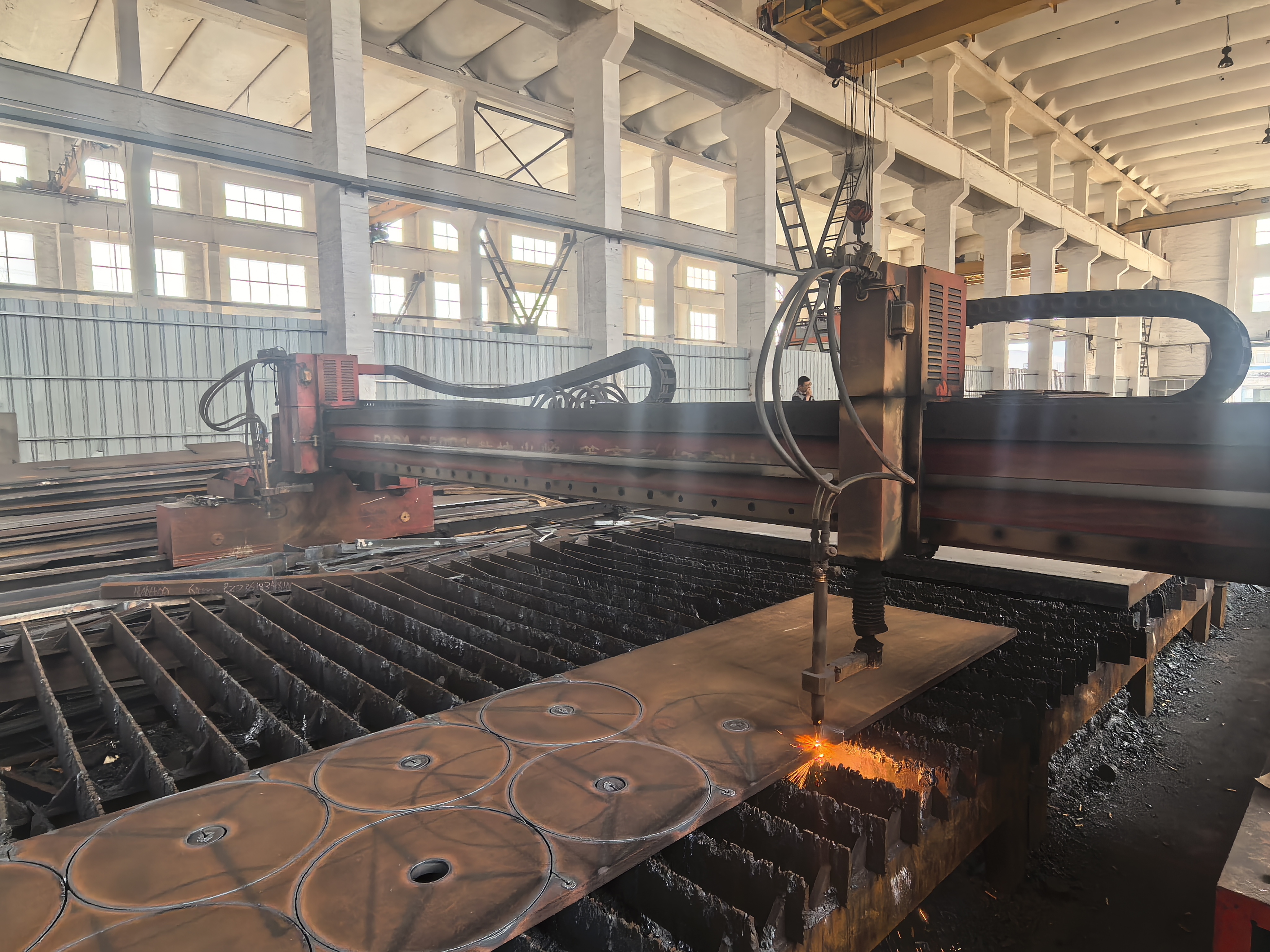
BGT Steel Plate processing center — cut-to-size wear resistant steel plate support for repeat and replenishment orders.
Have Questions or Need More Details?
Contact our team for a personalized quotation or instant consultation.
Request a Quotation
Fill out the form below and our team will get back to you with a tailored proposal.
WhatsApp Direct Chat
Prefer to chat in real-time? Message us on WhatsApp for instant assistance & quick answers.
- Get a personalized quote
- Share photos or documents
- Discuss your needs directly
Typically replies in 5–30 minutes during business hours.