
Wear Resistant Steel Plate for Railway Frogs and Jaw Crusher Plates: Application Guide
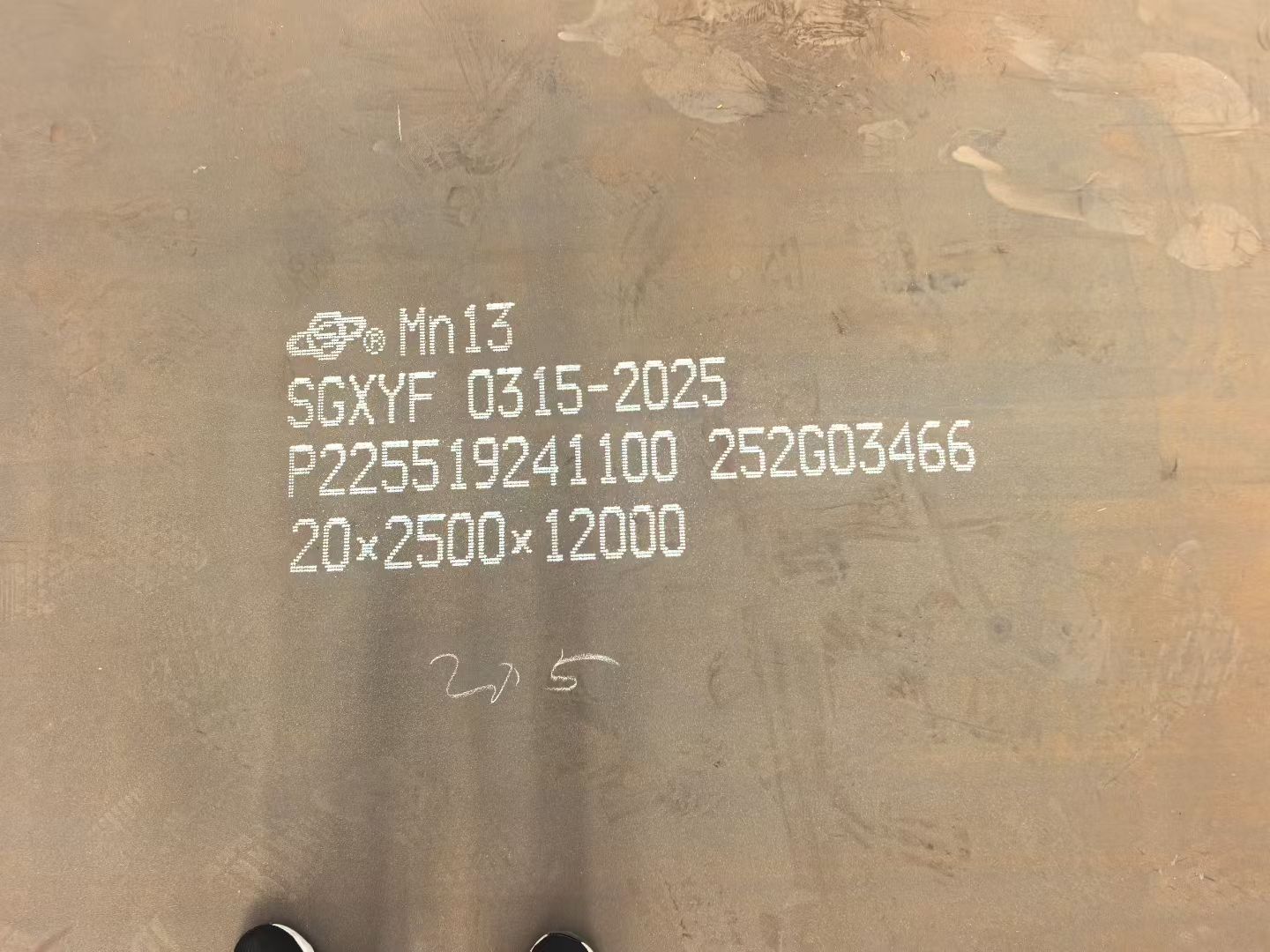
Mn13 high manganese steel plate, 20 mm: the grade most often specified for railway frogs, jaw crusher plates and shot blast liners where heavy impact drives the wear mechanism.
Railway frogs, jaw crusher plates and shot blast liners are all called wear parts, yet they fail for entirely different reasons. A turnout frog is struck by every passing wheel; a jaw plate absorbs crushing shock plus sliding abrasion; a shot blast liner is hammered continuously by abrasive media. Selecting all three on one hardness number is the most common cause of premature cracking, short service life and avoidable spend.
Short answer: specify Mn13 high manganese steel plate where heavy impact and compressive load dominate, because it work-hardens from roughly 200 HBW in the delivered condition to over 500 HBW at the working surface while the core remains tough and ductile. Specify quenched NM400, NM450, NM500, NM550 or NM600 where sliding abrasion dominates without significant impact. BGT Steel Plate (Jiangyin Baoguantao Import & Export Co., Ltd.) supplies both families in thickness from 3 mm to 150 mm and width from 600 mm to 3950 mm, with mill test certificates (MTC) from named Chinese mills and cut-to-size width and length matched to project dimensions.
Why These Three Parts Fail in Different Ways
Two distinct damage mechanisms are being mixed together whenever a frog, a jaw plate and a chute liner are ordered on the same line of a purchase requisition.
- Impact and compressive shock. Wheel loads on a turnout crossing, coarse rock entering a jaw chamber and abrasive media striking a blast cabinet liner all deliver repeated impact. A hard but brittle surface cracks, spalls and then breaks away in sections.
- Sliding abrasion. Ore sliding down a chute or gravel dragged across a truck bed removes material progressively, thickness millimetre by millimetre, without high impact energy.
Quenched and tempered NM grades rely on a martensitic matrix built by alloying and through-thickness quenching, which delivers uniform hardness from surface to core even as the top layer wears away. That structure is highly effective against abrasion, but it is not designed to absorb heavy repeated shock. Mn13 takes a different route: it is austenitic in the delivered condition, starts at around 200 HBW, and hardens dynamically at the working surface under impact and compression while the substrate stays ductile. The same property that protects it in a jaw chamber makes it the wrong choice for a pure sliding-abrasion chute with no impact, where a quenched NM plate is more economical.
A second, less discussed cost driver is fabrication and geometry. Grades at the top of the hardness range are more demanding to cold form and weld, and over-specifying them pushes fabrication cost up across the whole component. Standard mill sizes that do not match the part also create butt welds and drop scrap: an oversized frog block or jaw blank assembled from 6000 mm plate needs joining that a correctly sized plate would avoid.
Industry Background: Wear Plate Demand Is Concentrated in Mining
The demand structure behind these parts is heavily weighted toward impact-plus-abrasion duty. Market Research Future estimates the global wear resistant steel plate market at USD 1.756 billion in 2024 and projects USD 3.055 billion by 2035. Business Research Insights projects China's wear resistant steel market at USD 0.817 billion for 2025. A separate 2025 segmentation dataset published through Vertex AI Search Grounding placed mining at a 45.67% share of wear resistant steel plate demand.
Market sizing figures should be read with the definition in mind. Fact.MR's 2025 estimate of USD 32.73 billion covers all wear-resistant materials — ceramics and alloy systems included — rather than steel plate alone, which is why it sits far above the plate-only estimates above. For a procurement file, the practical conclusion is narrower than any headline number: the largest single application block is mining, and mining duty is characterised by impact combined with abrasion, which is exactly the profile where grade selection decides service life.
Trade documentation follows the same logic. Flat-rolled products of other alloy steel, of a width of 600 mm or more, not further worked than hot-rolled, fall under HS code 722540 — consistent with the fact that commercial wear plate width starts at 600 mm.
How Mn13 High Manganese Plate Works Under Impact
Mn13 (X12Mn12) is an austenitic manganese steel. Under heavy impact and compressive stress its surface hardness rises from roughly 200 HBW to over 500 HBW, while the material beneath the hardened layer stays tough and ductile. The hardened skin resists gouging; the tough core absorbs the shock that would crack a harder, more brittle plate. That combination is why Mn13 is used for railway frogs, jaw crusher plates, cone crusher mantles, shredder components and shot-blasting machine liners.
Selection boundary: Mn13 is suited to strong impact and compressive load. It is not suitable for pure abrasive wear without impact. Where the duty is low-impact sliding abrasion, NM series quenched plate is the more economical choice, and where NM400 or NM450 already satisfies the wear requirement, upgrading to a harder grade adds cost without adding life.
Because the hardening is generated by the application itself, the buyer cannot confirm the working hardness from the delivery certificate alone. What the certificate and the receiving inspection can confirm is the supplied condition and the grade identity — which is why documentation and incoming verification are treated as part of the specification, not as paperwork afterthoughts.
Grade Map: Mn13, NM400 to NM600, XCHD450, and Where Q690D Belongs
NM400, NM450 and NM500 are common Chinese commercial grades with hardness typically between 350 and 500 HBW. Within that band the trade-offs are life versus fabrication: NM450 is positioned as a balanced upgrade from NM400, offering roughly 12% to 15% higher service life in moderate-to-severe abrasion while keeping manageable fabrication properties; NM500 is selected where abrasion is heavy and replacement downtime is expensive, at higher material cost and slightly poorer formability. NM550 sits between NM500 and NM600 and is chosen when NM500 wears too fast. NM600, at approximately 600 HBW, targets severe abrasive wear such as sand chutes, slurry pipelines and cement plant equipment, and its cold forming and welding are difficult enough that strict technical specifications must be followed.
High-strength structural plate is a different category and should not be substituted for a wear face. Q690D has a minimum yield strength of 690 MPa and tensile strength of 770–940 MPa for thickness up to 50 mm under GB/T 16270-2009; the D suffix indicates impact toughness at −20 °C and E indicates −40 °C. These grades belong in support frames, brackets and structural members — not in the wear path of a frog or a jaw liner.
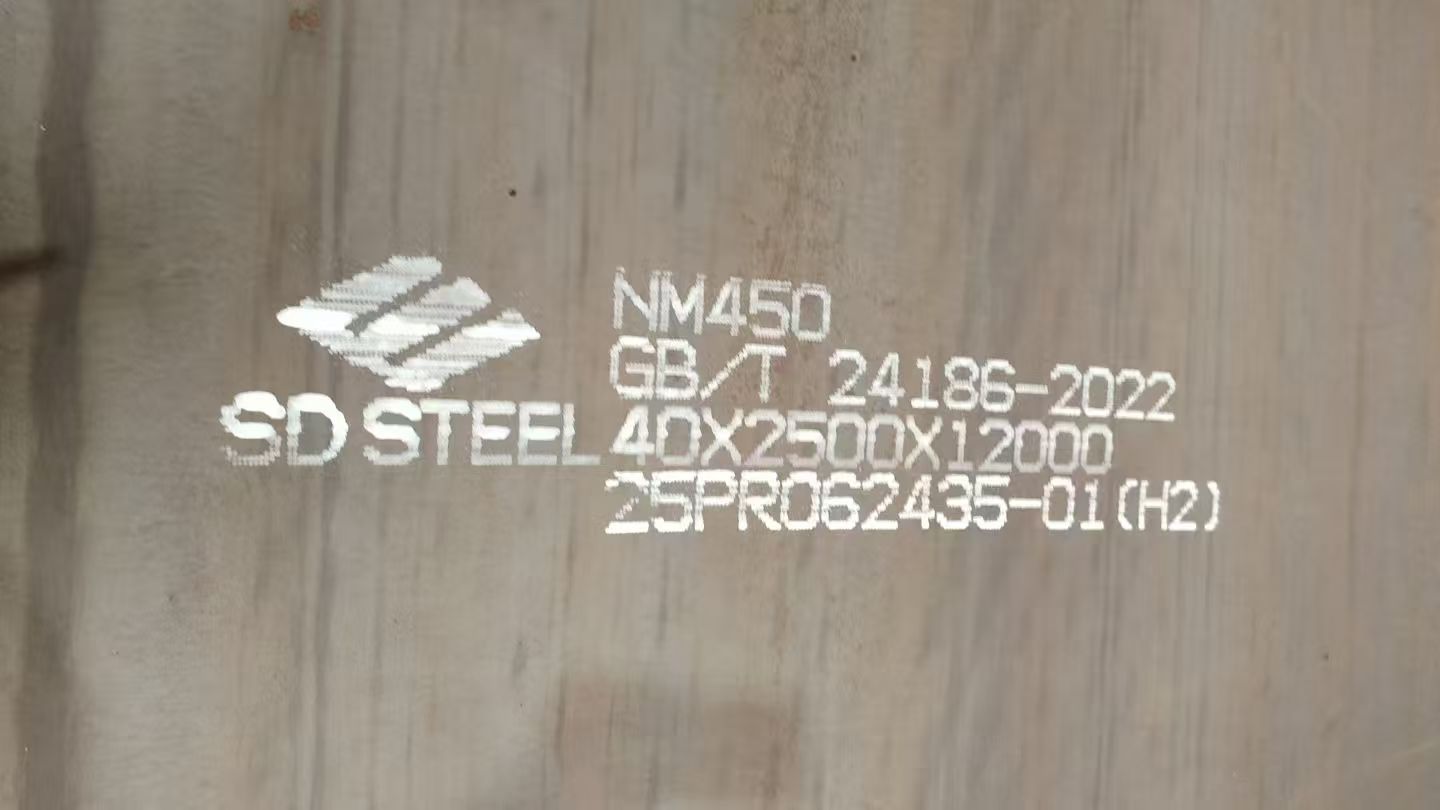
NM450 quenched plate in 40 mm: a balanced upgrade from NM400 for moderate-to-severe abrasion where impact loads are moderate.
| Grade | Metallurgy and wear mechanism | Hardness reference | Impact behaviour | Representative parts |
|---|---|---|---|---|
| Mn13 (X12Mn12) | Austenitic; dynamic work-hardening under impact and compression | ~200 HBW as supplied; over 500 HBW at the work-hardened surface | High toughness core absorbs heavy shock | Railway frogs, jaw crusher plates, cone mantles, shredder parts, shot blast liners |
| NM400 | Quenched and tempered martensitic, through-thickness hardening | Common commercial band 350–500 HBW; acceptance commonly 360–440 HBW | Not intended for heavy repeated shock | Dump truck bodies, excavator buckets, hoppers, general wear |
| NM450 | Quenched and tempered martensitic | Within the same commercial band; roughly 12–15% longer life than NM400 in moderate-to-severe abrasion | Moderate impact tolerance | Upgrade liners where NM400 wears too fast |
| NM500 | Quenched and tempered martensitic, higher hardness | Upper end of the 350–500 HBW commercial band | Higher hardness, slightly poorer formability | Concrete mixers, mining chutes, scrapers |
| NM550 | Quenched and tempered martensitic, intermediate grade | Above NM500 | Harder than NM500 | Heavy sliding abrasion where NM500 loses material quickly |
| NM600 | Highest commercial hardness plate; severe abrasive wear | Approximately 600 HBW | Cold forming and welding difficult; strict procedures required | Sand chutes, slurry pipelines, cement plant equipment |
| XCHD450 | Wear resistant plate grade | Grade designation per mill | Selected by duty, not by hardness alone | Mining machinery, garbage compactors, chutes, loader cutting edges |
| Q690D / Q690E | High-strength structural, not a wear grade | Yield ≥690 MPa; tensile 770–940 MPa up to 50 mm | D: −20 °C impact; E: −40 °C impact | Structural members, frames, brackets |
Hardness references are grade-level guidance. Confirm the actual delivered value on the mill test certificate and, where required, by third-party inspection.
Dimensions and Cut-to-Size: Matching Plate to the Component
Impact parts are rarely built from a stock sheet. A frog block, a jaw plate blank or a blast cabinet liner has its own outline, bolt pattern and wear allowance, and every unnecessary joint becomes a stress concentration in a part that already sees shock loading.
Available plate dimensions are 3 mm to 150 mm in thickness and 600 mm to 3950 mm in width, with lengths of 2438 mm, 5800 mm, 6000 mm, 6096 mm, 12000 mm and 12200 mm. Customized width and length are accepted, which is the practical lever for reducing fabrication cost: a plate cut to the finished outline removes butt welds, cuts drop scrap and shortens cutting and fit-up time in the customer's workshop.
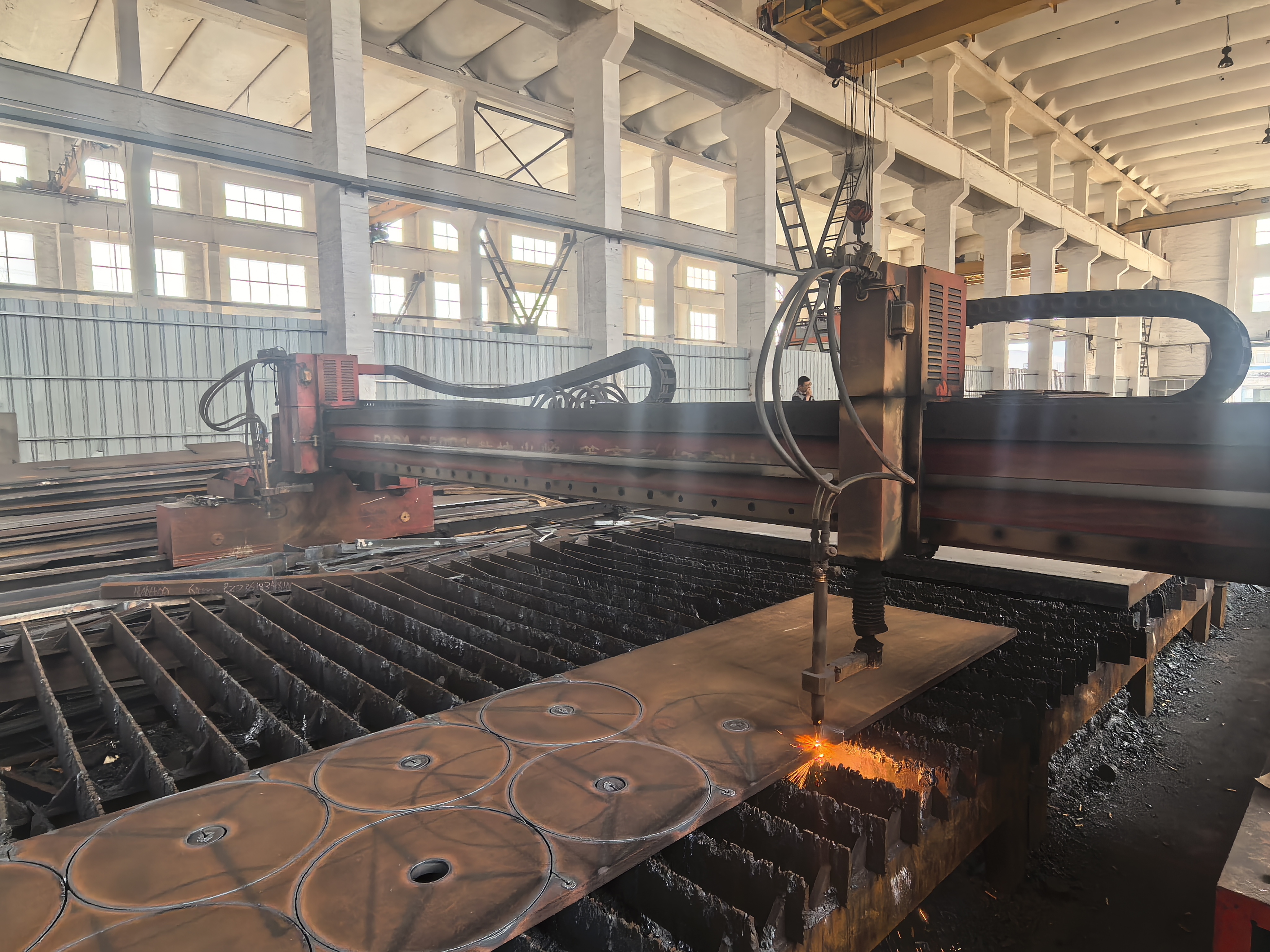
Cut-to-size processing: supplying wear plate in project width and length instead of standard mill sizes reduces joints and drop scrap in impact components.
Thickness selection is a separate decision from grade selection and depends on the wear allowance the component can carry and the impact energy it absorbs. That calculation is best done with the mill's technical data and the supplier's engineering input rather than by copying the thickness of a part that failed.
Documentation: MTC From Named Mills and Third-Party Inspection
Wear plate is a specification purchase, so the delivery documentation is part of the product. BGT Steel Plate provides mill test certificates (MTC) for wear resistant steel plate deliveries, and third-party inspection can be arranged. The plates are sourced through long-term distribution relationships with named domestic mills — Xingcheng, Nisco, Shougang, Xisc, Shandong-Steel, Hanye, Tangsteel, Rongshen, Tisco, Baosteel, Lianyuan and Puyang — which keeps grade identity and heat traceability attached to each delivery.
On the receiving side, hardness verification is a defined procedure rather than a quick spot check. Test at least 50 mm away from flame or plasma cut edges to stay clear of the heat-affected zone, and grind away 1.5–2.0 mm to expose bright metal instead of testing the raw surface. For plates from 6 mm to 80 mm — the most common range for wear parts — the standard parameter is HBW 10/3000. Take three consecutive readings at least 10 mm apart and evaluate the average against the grade tolerance, for example 360–440 HBW for NM400. Grinding must not overheat the surface, because tempering produces falsely low readings.
Step-by-Step: Specifying Wear Plate for Frogs, Jaw Plates and Blast Liners
Classify the wear mode
Write down impact energy, compressive load and abrasiveness separately. Railway frogs and jaw plates operate under severe impact with work hardening; shot blast liners under continuous impact from abrasive media; chutes and hoppers under sliding abrasion; vertical mill scrapers under severe wear with low impact.
Fix the material family before the grade number
Impact-dominated duty points to Mn13. Abrasion-dominated duty points to NM400, NM450, NM500, NM550 or NM600, depending on how quickly the current part loses thickness. Structural members belong to Q690D or Q690E, not to a wear grade.
Set the acceptance values
State the hardness band and the report required. For NM400, for example, an acceptance band of 360–440 HBW gives the receiving inspection a clear pass/fail line instead of a vague grade name.
Plan the cut before ordering the plate
Compare the finished outline against the available 600–3950 mm width and the standard lengths. Where the part is wider than a stock width, custom width and length removes a seam; where several small liners come from one plate, a nested cut plan reduces scrap.
Define documentation and inspection scope
Require the MTC per delivery with grade, heat and mechanical values, and decide in advance whether third-party inspection applies and at which stage.
Run a trial quantity
A trial order validates cut quality, flatness and hardness before a full liner set is committed. BGT Steel Plate sets a minimum order quantity of 1 ton, which supports trial and sample-scale orders, with a lead time of 7 to 10 days.
Verify on arrival and set a reorder trigger
Check dimensions, grade marking and hardness using the procedure above, record the readings, and use the measured wear rate of the first set to set the reorder point — not the calendar.
Use Cases: Where Each Grade Fits
Railway frogs and turnout crossings
A turnout frog carries intermittent shock loading with severe impact at the running surface. Mn13 is the appropriate specification here: the surface work-hardens under wheel load while the tough core resists the shock that would crack a harder plate. Because frogs are large, non-standard castings and forgings, cut-to-size width and length matter as much as the grade — a plate that arrives closer to the finished outline reduces both welding and machining.
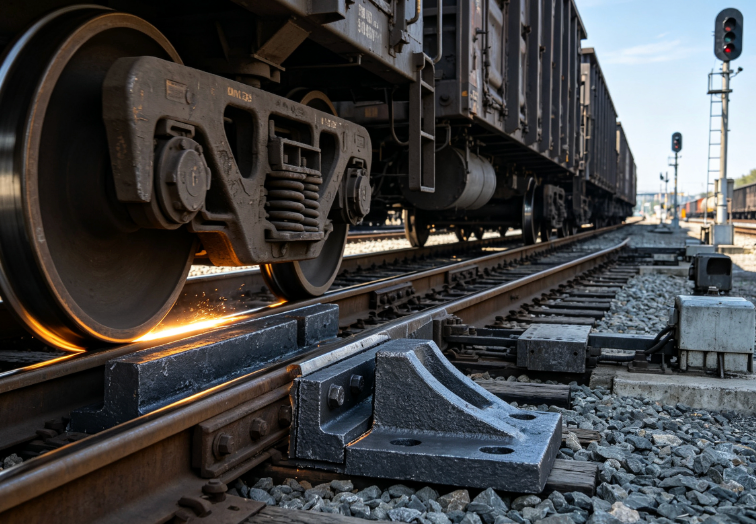
Railway turnout crossing: intermittent shock loading plus severe impact — the duty profile that justifies Mn13 rather than a quenched abrasion grade.
Jaw crusher plates and other crusher wear parts
Jaw crusher plates combine coarse-rock impact with abrasion, which is why Mn13 is used for jaw plates and cone mantles. Where a crusher runs a fine, low-impact feed and the dominant loss is sliding abrasion, a quenched NM grade can be the more economical option — the decision follows the chamber duty, not the equipment name.
Shot blast liners
Shot-blasting machine liners are struck continuously by abrasive media, so Mn13 is the standard reference grade. Cabinets and sections that see media flow rather than direct impact can be reviewed on an abrasion basis instead.
Adjacent applications served by the same stock
The same supply base covers wear-resistant components in mining machinery, garbage compactors, chutes and loader cutting edges; excavator buckets, dump truck beds and crusher liners; mining liners, severe-wear hoppers and ore convey pipe liners; and vertical mill scrapers designed for severe wear with low impact.
| Application | Dominant wear mode | Specification direction | Why |
|---|---|---|---|
| Railway frog / turnout crossing | Severe impact with work hardening | Mn13 | Surface hardens above 500 HBW while the core stays tough |
| Jaw crusher plates, cone mantles | Impact plus abrasion | Mn13 | Repeated shock requires a ductile substrate |
| Shot blast machine liners | Continuous impact by abrasive media | Mn13 | Work-hardening surface resists gouging |
| Mining chutes, hoppers, ore convey pipe liners | Sliding abrasion, medium impact | NM400 / NM450 / NM500 | Hardness governs life; formability and weldability stay manageable |
| Dump truck beds, excavator buckets | General abrasion | NM400, with NM450 as an upgrade | Balanced wear resistance and fabrication |
| Cement plant hoppers, sand chutes, slurry lines | Severe abrasive wear | NM500 / NM550 / NM600 | Higher hardness where replacement downtime is costly |
| Vertical mill scrapers | Severe wear, low impact | High-hardness wear grade | No impact benefit from Mn13; abrasion dominates |
Delivered references
Two shipments illustrate how the specification is applied in practice. A shredder equipment manufacturer in Vietnam ordered 180 pieces of wear resistant steel plate for shredder blade fabrication, with high wear resistance as the stated result. A mining equipment manufacturer in Russia ordered 200 tons for dump truck floor and side liner fabrication, where the requirement was balanced toughness and wear resistance rather than maximum hardness.
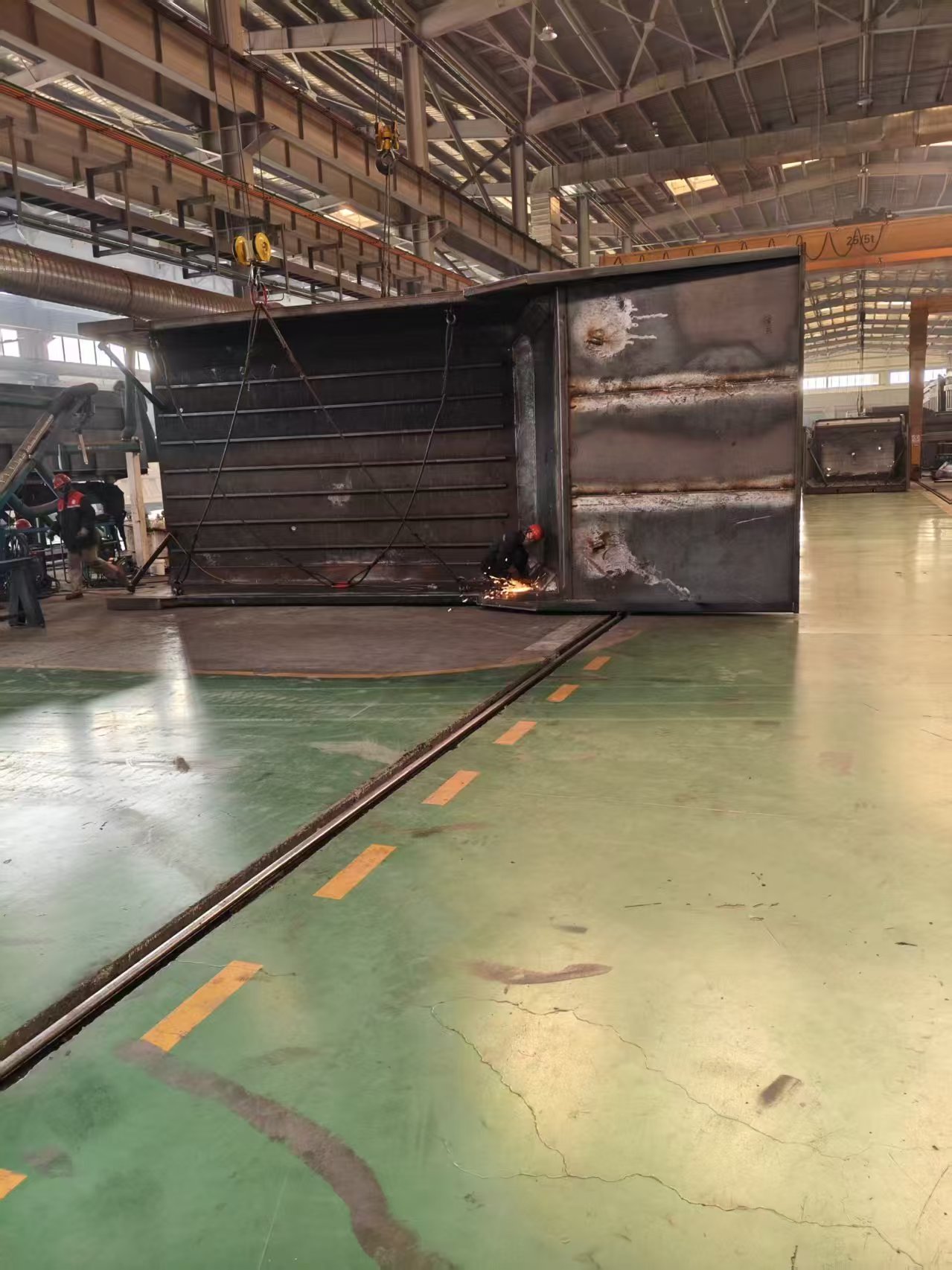
Mining dump truck floor and side liner project (Russia, 200 tons): toughness and wear resistance balanced for a mixed impact-and-abrasion duty.
Building a Shortlist for 500 HBW Abrasion Resistant Plate
Most requests for 500 HBW plate are really requests for a reliable supply route. The grade is common; what varies is traceability, cut capability and delivery certainty. A practical shortlist screens suppliers on five points.
- Grade identity and traceability. Can the supplier name the mill behind each plate and issue an MTC per delivery? Mill relationships matter more than a grade label, because the certificate is what the receiving inspection is checked against.
- Verification, not assertion. Is third-party inspection available, and is hardness tested to a defined procedure rather than quoted from a catalogue?
- Cut-to-size capability. Can the supplier deliver project width and length within 600–3950 mm width and the standard length range, so the buyer does not pay for seams and scrap?
- Stock depth and response time. Stock position determines whether a liner set ships in days or weeks. BGT Steel Plate holds standing inventory of over 30,000 metric tons across 12 warehouses in Jiangsu, Shandong and Hunan, operates a 5,000 m² facility with 40 employees and a 3-engineer technical team, and reports a monthly capacity of 30,000 tons of wear resistant steel plate with a 7–10 day lead time.
- Technical support after delivery. Work-hardening grades and high-hardness grades both fail at fabrication if welding and forming are handled casually; after-sales technical guidance and on-site consultation are part of the specification.
BGT Steel Plate was established in 2013 and exports to the Middle East, Southeast Asia, South America, Africa, Central Asia and Russia, with wear resistant and high strength steel plate as its main product lines. For buyers assembling a shortlist, that combination — named-mill MTC, third-party inspection option, cut-to-size width and length, and a 1 ton minimum order for trials — is the part that can be checked rather than assumed.
FAQ
What documentation is supplied with Mn13 and NM wear plate shipments?
Each delivery is accompanied by a mill test certificate (MTC), which records grade and mechanical values against the mill that produced the plate. BGT Steel Plate sources through long-term distribution relationships with named mills including Xingcheng, Nisco, Shougang, Xisc, Shandong-Steel, Hanye, Tangsteel, Rongshen, Tisco, Baosteel, Lianyuan and Puyang, so the certificate can be traced to a specific mill. Third-party inspection can be arranged where the buyer's quality plan requires it. Flat-rolled alloy steel of 600 mm width or more, hot-rolled, is classified under HS code 722540 for customs purposes.
Can wear plate be cut to project width and length instead of standard plate sizes?
Yes. Plate is available from 3 mm to 150 mm in thickness and 600 mm to 3950 mm in width, with lengths of 2438 mm, 5800 mm, 6000 mm, 6096 mm, 12000 mm and 12200 mm, and customized width and length are accepted. Production services include OEM and ODM modes, with customization of chemical composition, mechanical properties and logo. For frog blocks, jaw plate blanks and liner sets, ordering to the cut plan removes butt welds and reduces drop scrap.
Is Mn13 more expensive than NM400 for jaw crusher plates?
They are different value cases rather than a simple price comparison. Mn13 is specified where strong impact and compressive load dominate, and in those conditions it delivers the strongest service-life value because the surface work-hardens from roughly 200 HBW to over 500 HBW while the core stays tough. NM400 is the more economical choice for general abrasion without high impact, such as dump truck bodies, excavator buckets and hoppers. Overspecifying either direction adds cost: a harder grade than the duty requires does not extend life, and Mn13 in a pure sliding-abrasion chute buys toughness the application cannot use.
What is the minimum order quantity for a trial order?
The minimum order quantity is 1 ton, which supports trial and sample-scale orders of wear resistant steel plate. A trial lot is the sensible way to confirm cut quality, flatness and hardness on a real liner outline before committing to a full set.
How quickly can cut-to-size Mn13 or NM plate be delivered?
Lead time is 7 to 10 days, supported by a monthly capacity of 30,000 tons of wear resistant steel plate and standing inventory of over 30,000 metric tons held across 12 warehouses in Jiangsu, Shandong and Hunan. To move from enquiry to a quotation, send the component drawing or cut list with grade, thickness, width and length; the technical team can review the duty and confirm the grade before the plate is cut. The full product range is available in the BGT Steel Plate catalogue (PDF).
Conclusion: Specify the Duty, Then the Grade
Railway frogs, jaw crusher plates and shot blast liners all benefit from the same discipline: classify the wear mode first, then choose the material family, then fix the acceptance values and the cut plan. Mn13 earns its place where heavy impact and compressive shock dominate, because work-hardening converts the application's own load into a surface above 500 HBW over a tough core. NM400 through NM600 earn their place where abrasion dominates and hardness governs life. Q690D and Q690E belong in the structure, not the wear path.
What separates a specification that works from one that only looks correct is the detail around the plate: named-mill MTC, a defined hardness verification procedure, cut-to-size width and length inside 600–3950 mm, and a trial quantity that proves the supply before the full set is ordered.
Send your drawing or cut list
BGT Steel Plate (Jiangyin Baoguantao Import & Export Co., Ltd.) supplies Mn13 high manganese plate and NM400–NM600 wear plate from 3 mm to 150 mm thickness, cut to project width and length, with MTC from named mills. Minimum order 1 ton, lead time 7–10 days.
Email: sales@bgtsteel.com · Tel / WhatsApp: +86 189-1230-2159 · Website: www.bgtsteel.com
Download the catalogue: BGT Steel Plate product catalogue
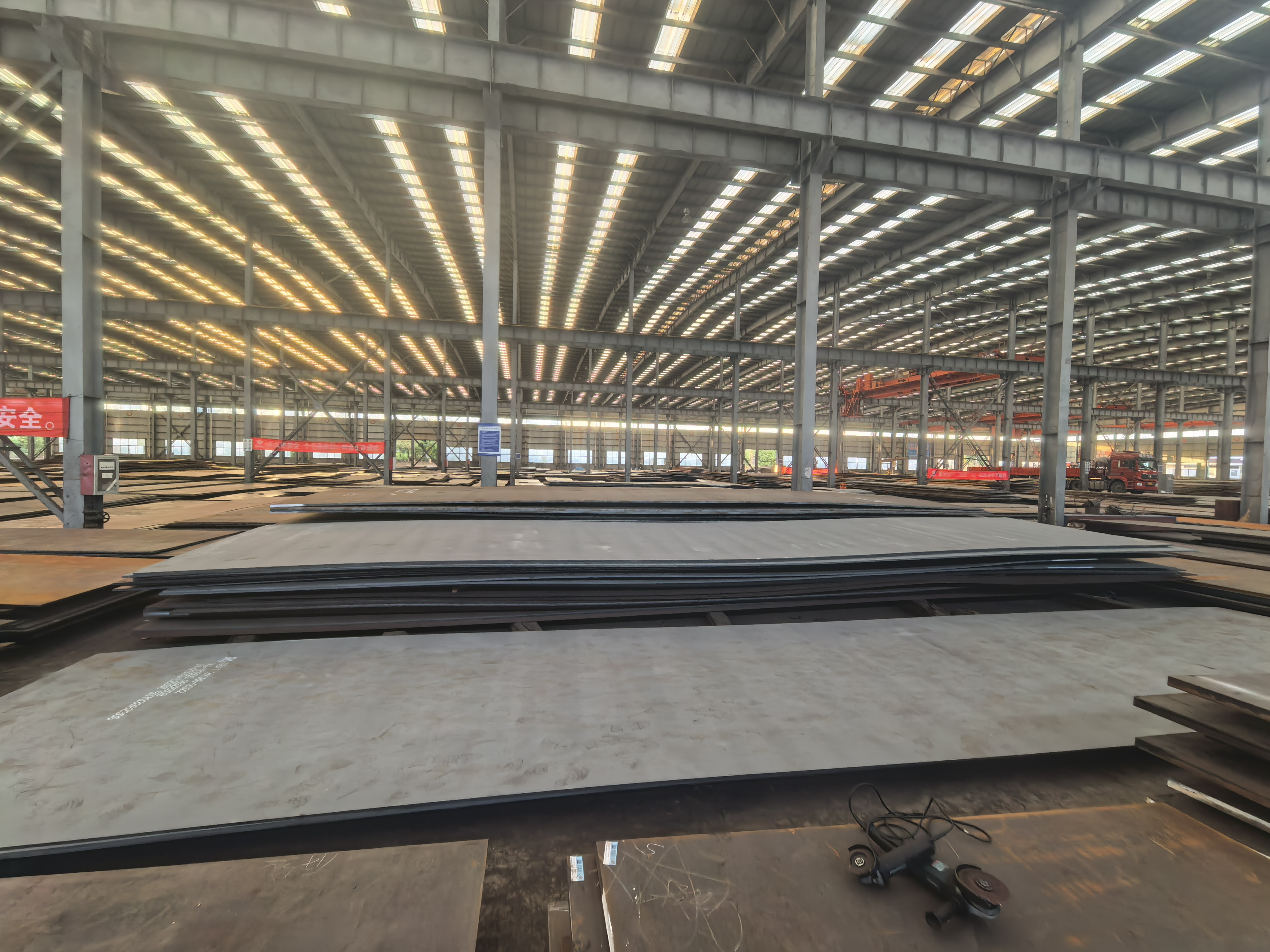
Warehouse stock: over 30,000 metric tons of wear resistant steel plate held across 12 warehouses in Jiangsu, Shandong and Hunan.
Have Questions or Need More Details?
Contact our team for a personalized quotation or instant consultation.
Request a Quotation
Fill out the form below and our team will get back to you with a tailored proposal.
WhatsApp Direct Chat
Prefer to chat in real-time? Message us on WhatsApp for instant assistance & quick answers.
- Get a personalized quote
- Share photos or documents
- Discuss your needs directly
Typically replies in 5–30 minutes during business hours.