
Wear Plate Import Compliance: MTC, Mill Origin, Grade Checks
Cross-Border Compliance Guide for Wear Resistant Steel Plate: MTC, Mill Origin, and Grade Acceptance
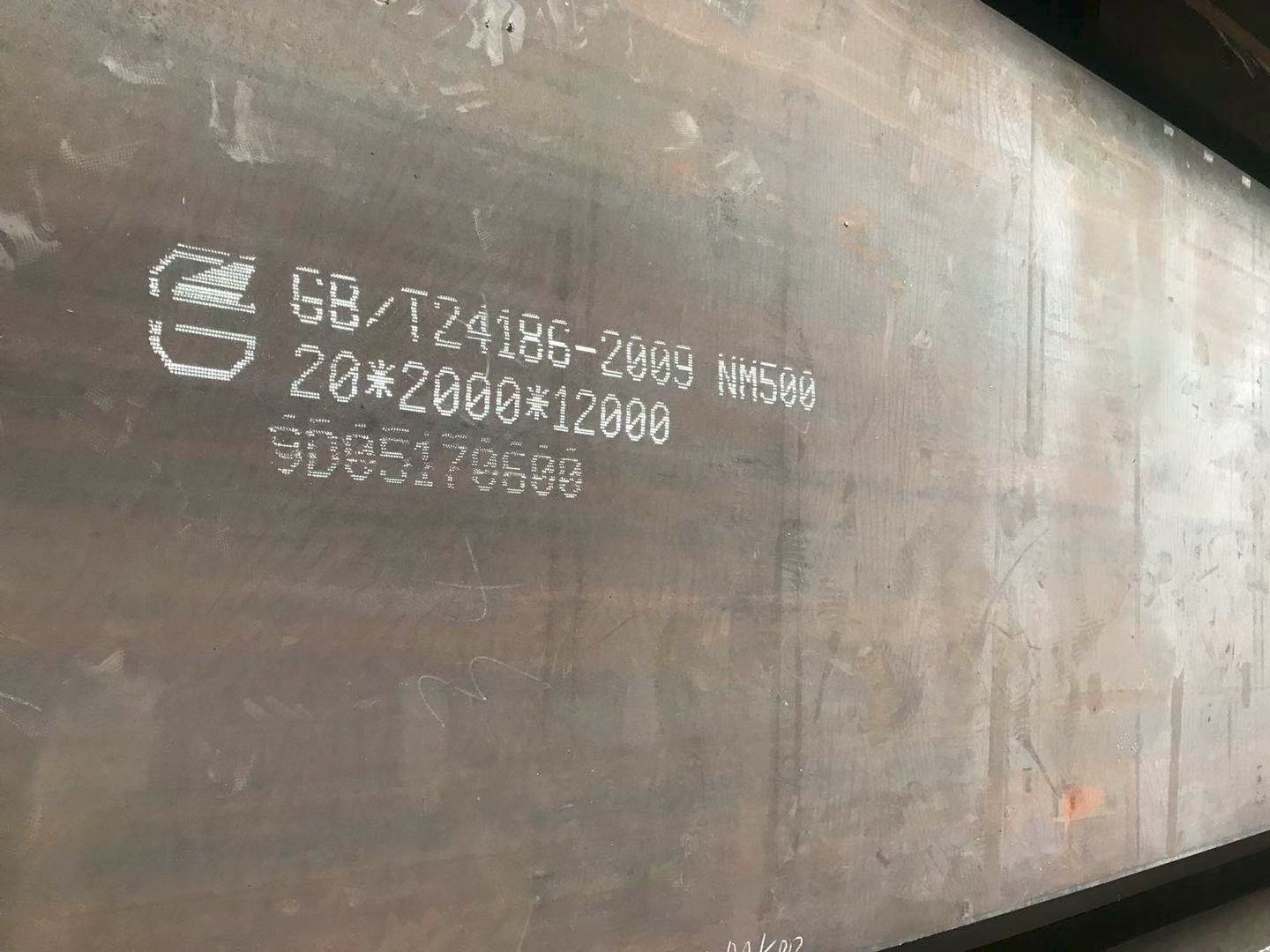
Cover image: NM500 wear resistant steel plate, 20 mm. Image source: BGT Steel Plate product data.
Cross-border compliance for wear resistant steel plate is not proven by a single certificate or a grade name printed on an invoice. The buyer's core control is a three-way match: the grade and mill stated in the purchase order, the data in the original Mill Test Certificate (MTC), and the identification on the delivered plate and packing documents. If those three do not agree, the shipment may still be wear-resistant steel, but it is not yet an accepted delivery.
BGT Steel Plate (Jiangyin Baoguantao Import & Export Co., Ltd.) is a China-based supplier of wear resistant steel plates and high strength steel plates, established in 2013. Its supplied product data covers NM400, NM450, NM500, Mn13, Q550D, Q690D, Q960E and XCHD450, and states that the listed products are supplied with an original MTC. That is the starting point for the checks below, not a substitute for order-specific verification.
What compliance means in a wear plate import file
Compliance is the evidence chain that connects the ordered material to the shipped plate. For wear resistant steel plate, that chain normally contains four elements: the technical purchase order, the original MTC, the physical plate marking and dimensions, and the commercial shipping documents. A certificate of conformity, a product brochure or a grade label cannot replace the missing link.
The same commercial grade name can be offered by different mills, and one mill can supply several wear and high-strength grades. That is why grade acceptance and mill-of-origin traceability are separate checks. The grade tells the buyer what material family and property level is required. The mill of origin identifies the producer whose test certificate and process data support that grade. A trader or stockholder can sell and process the plate, but it does not become the mill of origin merely because it issued the invoice.
The practical risk appears when a buyer orders NM400 but receives an MTC for a different heat, a certificate naming a trading company without the producing mill, a plate marked only with a commercial equivalent, or a cut-to-size delivery whose pieces cannot be linked back to the mill plate. Each of these is a documentation defect even if the steel looks correct.
Why MTC and mill of origin are separate acceptance fields
An MTC records the producing mill's test data and the identity of the material it tested. Mill of origin identifies which mill produced the plate. A buyer should not accept a certificate from an intermediary as though it were a mill certificate unless the contract expressly allows that document and defines its content. For the products in BGT's supplied data, the stated position is an original MTC; the buying file should preserve that original and match it to the order.
The mill-of-origin list in BGT's product data includes Xingcheng, Nisco, Shandong Steel, Shougang, Xisc, Lianyuan, Puyang, Rongshen and Yongfeng. This is a mill-origin reference for the listed products. It is not a certification list, and it does not by itself prove that every mill, grade, thickness or project approval is interchangeable. A named mill still has to be matched to the exact grade, heat and delivery documents in the order.
The distinction matters at customs and at receiving inspection. Customs classification and origin rules depend on the goods, processing and importing-country requirements. The MTC is a quality document; a certificate of origin is a trade document. Neither should be used as a substitute for the other.
Purchase order controls that make acceptance enforceable
A supplier cannot be held to an acceptance criterion that the purchase order never defined. The technical schedule should therefore lock the following items before price and delivery are settled:
- Grade family and exact designation. State whether the plate is a wear grade such as NM400, NM450 or NM500, a work-hardening manganese grade such as Mn13, a high-strength structural grade such as Q550D, Q690D or Q960E, or a named grade such as XCHD450. Avoid wording such as wear plate or NM400 or equivalent unless the equivalence criteria are attached.
- Dimensions and tolerances. The supplied product data covers a thickness range of 3 to 150 mm and a width range of 600 to 3950 mm, with customized sizes accepted. Standard lengths include 2438, 5800, 6000, 6096, 12000 and 12200 mm, and customized lengths are accepted. The order should state the delivery size and whether the MTC will show the mill plate size or the cut size.
- Mill of origin. Name the acceptable producing mills or the approval process for a mill substitution. If the contract requires a named mill, a generic major mill statement is not enough.
- Original MTC and required fields. Define that the MTC must identify the producing mill, heat number, plate identity where applicable, grade, dimensions and required test results. If an electronic original is acceptable, say so in the contract.
- Inspection and test scope. State whether hardness testing, UT inspection, third-party inspection or witnessed testing is required. BGT's capability data lists MTC and third-party inspection as quality-control elements; the order must still define which inspection applies to the shipment.
- Marking and traceability. Require the grade, heat number or plate identity, dimensions and purchase order reference to appear in the agreed place on the plate, packing list or label.
- Acceptance, rejection and remedy. Define what happens if documents do not match, if the mill is substituted without approval, or if test results fall outside the agreed range.
Delivery terms such as FOB, CIF or EXW affect risk transfer and freight, but they do not replace technical acceptance. A shipment can transfer risk at the agreed point and still fail document acceptance on arrival. The technical and document clauses should stand independently of the Incoterm.
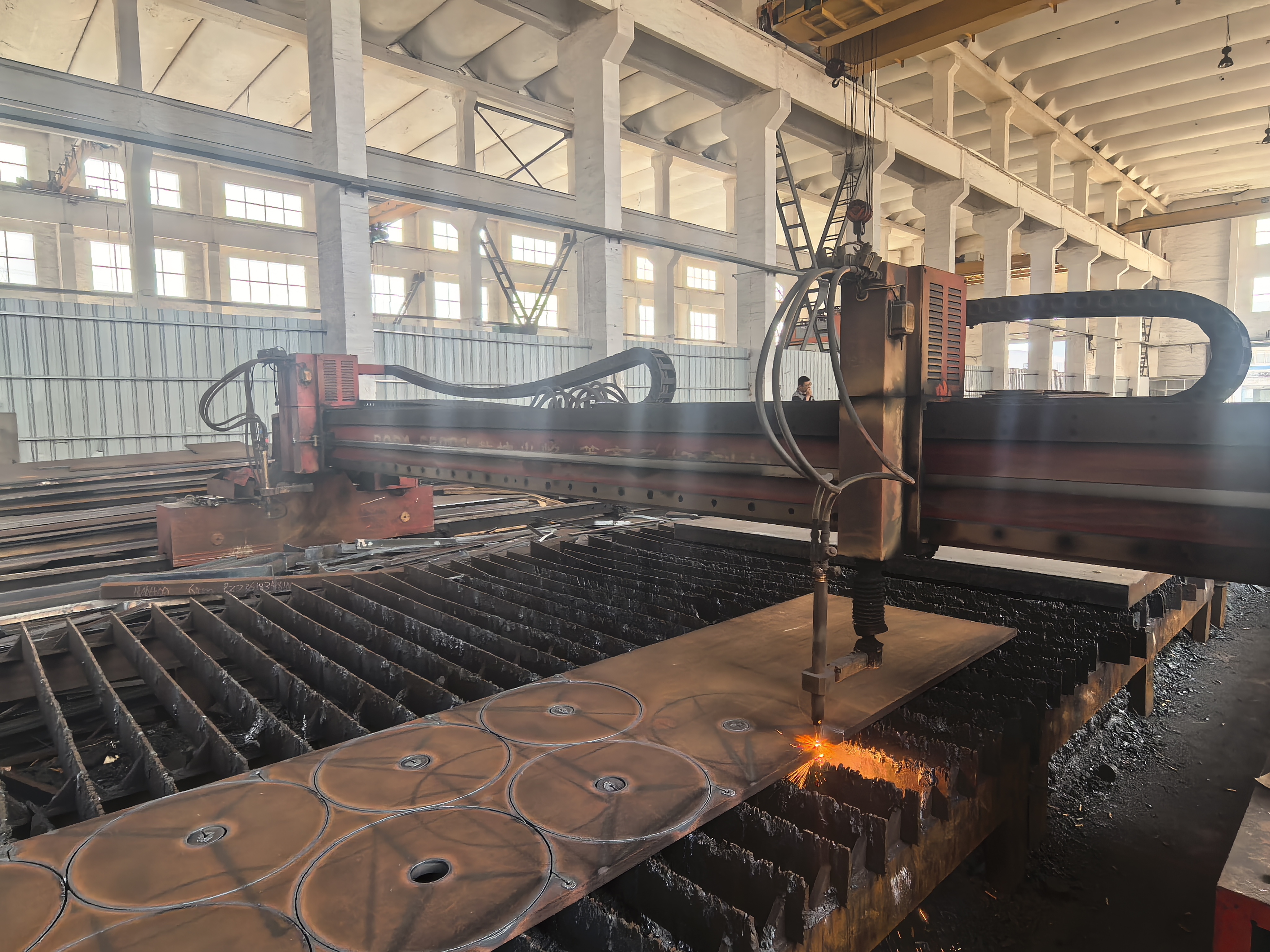
Processing center image: cut-to-size and order handling should preserve traceability to the original mill plate.
How to verify an original Mill Test Certificate
An MTC is a test document, not a marketing sheet. The buyer's review should be systematic and should leave a copy in the order file. The exact layout differs by mill, so the purchase order should define the minimum fields rather than assuming that every certificate looks the same.
- Check the issuer. The certificate should identify the producing mill, not only the seller or stockholder. If BGT supplies the plate, BGT is the supplier; the mill named on the MTC is the producer whose heat and test data are being relied on.
- Check the certificate status. Confirm that the document is the original required by the contract, that it is signed or stamped as the mill normally issues it, and that it has not been altered. If a mill-signed electronic original is proposed, confirm acceptance before shipment.
- Match the heat and plate identity. The heat number on the MTC should link to the plate marking, packing list and invoice. For cut-to-size orders, the original mill plate identity should be traceable to the delivered pieces through the supplier's cutting record.
- Match grade and dimensions. The grade on the MTC should match the purchase order exactly. The dimensions should be consistent with the ordered mill plate and with any agreed delivered size. A different grade with similar hardness is not an acceptable substitution unless the buyer approves it in writing.
- Review chemical and mechanical results against the order. For Q690D, a public steel-grades reference cited in the supplied data lists GB/T 16270-2009, a minimum yield strength of 690 MPa and a tensile strength of 770 to 940 MPa for thickness up to 50 mm. For Q550D, the supplied FAQ data states a minimum yield strength of 550 MPa. These are grade-specific checks; they are not wear-plate hardness checks.
- Review hardness with its method. For wear grades, the MTC hardness value should be read together with the test method and location. The supplied hardness-testing guidance uses HBW 10/3000 for common 6 to 80 mm plate, grinding 1.5 to 2.0 mm below the surface and testing at least 50 mm from a cut edge. It also uses 360 to 440 HBW as an example verification band for NM400/AR400. The exact acceptance band and method should be written into the order.
- Check impact or toughness data where specified. High-strength grades can have impact-toughness requirements that are not visible from a hardness number. Q690D and Q690E are distinguished by impact temperature in the supplied FAQ data, with D associated with -20 degrees C and E with -40 degrees C. Q960E is described as combining high tensile strength with toughness at -40 degrees C.
- Reconcile the MTC with commercial documents. The mill, grade, heat, quantity and dimensions should agree across the MTC, invoice, packing list and bill of lading or equivalent transport document. A correct MTC attached to the wrong shipment is still a traceability failure.
When third-party inspection is specified, the inspection scope should be agreed before production. A third-party report can add evidence, but it does not repair an MTC that names the wrong mill or grade. The buyer should define the order of review: contract first, MTC second, physical identification third, and third-party report as an additional layer where required.

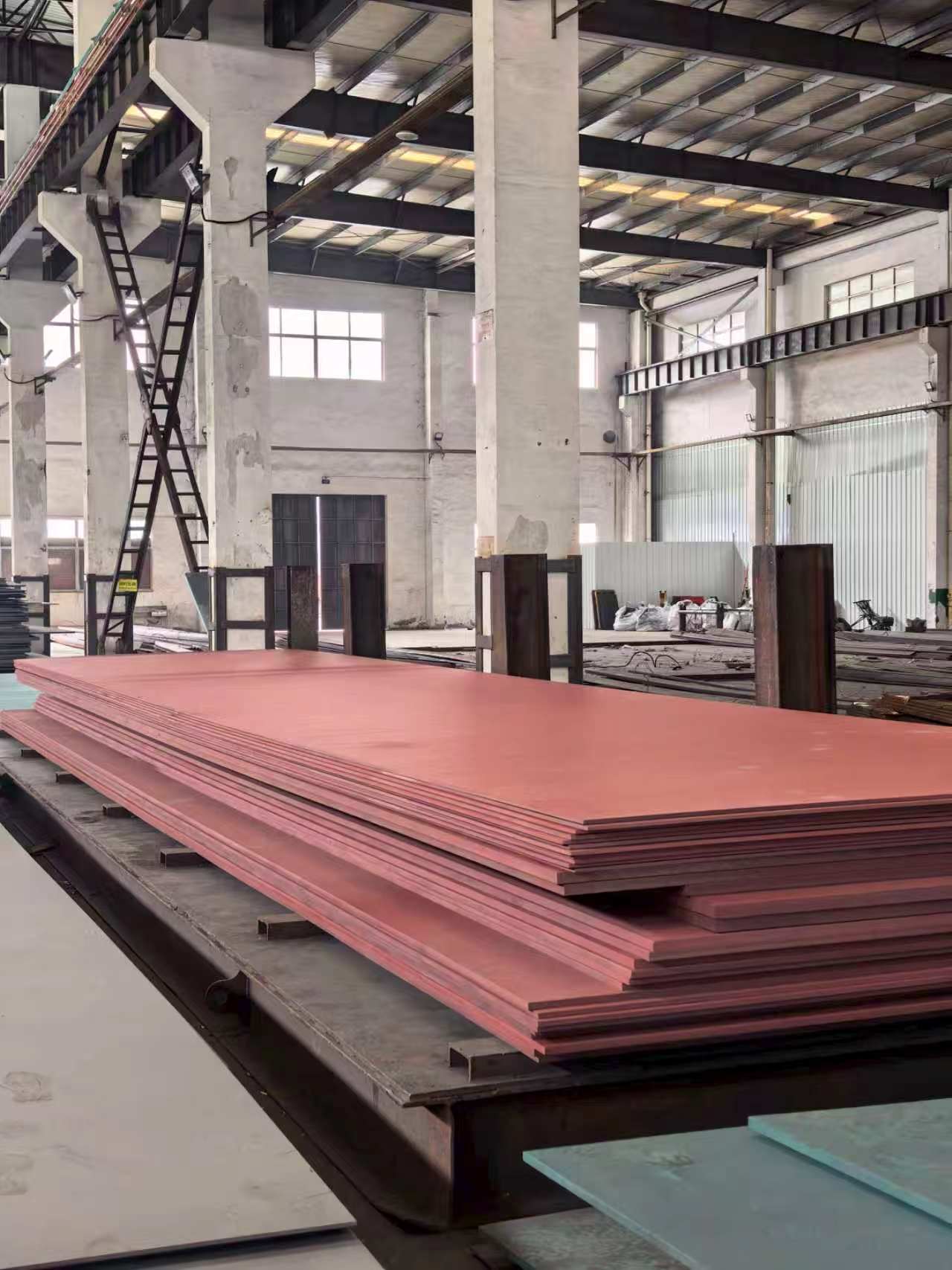
Warehouse image: stock and packing references must reconcile with the mill certificate and shipping documents.
Mill-of-origin traceability: what the file should show
Traceability should show a continuous link from the producing mill to the delivered plate. At minimum, the file should allow a reviewer to move from the purchase order to the mill name, from the mill name to the heat number, from the heat number to the MTC results, and from the MTC to the invoice and packing record. If any link is missing, the buyer has a document exception to resolve before release to fabrication.
For the listed BGT products, the steel mills of origin named in the supplied product data are Xingcheng, Nisco, Shandong Steel, Shougang, Xisc, Lianyuan, Puyang, Rongshen and Yongfeng. A buyer should not treat that list as a ranking or as proof of a particular certification. It is a traceability reference. The actual order confirmation, MTC and packing documents must identify the mill used for that shipment.
Cut-to-size supply adds one more step. The mill plate may be wider or longer than the delivered part, so the MTC dimensions and the packing list dimensions can differ legitimately. The control is a cutting record that links the delivered part to the original mill plate and heat. Without that link, a buyer may have a correct MTC for a plate that cannot be connected to the delivered components.
Grade acceptance for NM400, NM500, Mn13, Q550D, Q690D, Q960E and XCHD450
Grade acceptance begins with the material family. NM400, NM450, NM500 and XCHD450 are wear-resistant plate designations in the supplied data. Mn13 is a work-hardening high manganese steel plate. Q550D, Q690D and Q960E are high-strength structural plates. A certificate for one family does not establish acceptance for another, even if the plate is thick and strong.
NM400
The supplied data positions NM400 as the general wear grade for applications such as dump truck boxes, excavator buckets and hoppers, with a balance of wear resistance, formability and weldability. Its nominal hardness is 400 HBW. For acceptance, check the exact NM400 grade, the original MTC, the agreed hardness result and the dimensions. The supplied hardness-testing guidance uses 360 to 440 HBW as an example verification band for NM400/AR400, but the exact band and method should be confirmed in the purchase order rather than assumed from the grade name alone.
NM450
NM450 is described as an intermediate upgrade when NM400 wears too fast under the same working condition. Supplier comparison data in the supplied corpus states roughly 12 to 15 percent higher service life in moderate-to-severe abrasion environments while maintaining manageable fabrication properties. That is a supplier comparative statement, not a guarantee for every site. Acceptance should require the exact NM450 designation, an original MTC and the agreed dimensions; an automatic substitution with NM400 or NM500 should not be accepted without written approval.
NM500
NM500 is listed at 500 HBW and is intended for heavy abrasive wear conditions such as mining chutes, concrete mixers and scrapers, where replacement downtime is costly and extra surface hardness is required. It offers higher hardness and longer service life than lower grades, but the supplied data also notes higher material cost and slightly poorer formability. Acceptance should confirm the NM500 grade, hardness result, MTC and dimensions. For forming-critical parts, the fabrication method should be confirmed before order because the higher hardness grade is not interchangeable with NM400 in every workshop process.
NM450 plate: grade, hardness and MTC should be checked against the purchase order.
Mn13 high manganese steel plate
Mn13 is an austenitic work-hardening grade, not a quenched wear plate. The supplied FAQ data explains that it hardens under heavy impact and compressive stress, with surface hardness rising from about 200 HBW to over 500 HBW while the core remains tough. Typical applications include railway frogs, jaw crusher plates and shot blast liners. Acceptance should match the Mn13 grade and the impact application. A buyer should not require a single high HBW at delivery as if Mn13 were NM500, and should not specify Mn13 for pure abrasive wear without impact where the work-hardening mechanism is not engaged.
XCHD450
XCHD450 is described for medium-to-high wear applications and maintains cold-formability and weldability. The supplied product data states that its wear life is approximately 15 to 20 percent longer than NM400 under comparable conditions. That statement should be read as supplier data tied to comparable conditions, not as a universal site result. Acceptance should name XCHD450 exactly and require an original MTC; a commercial equivalent label is not enough to convert an XCHD450 order into an NM400 order.
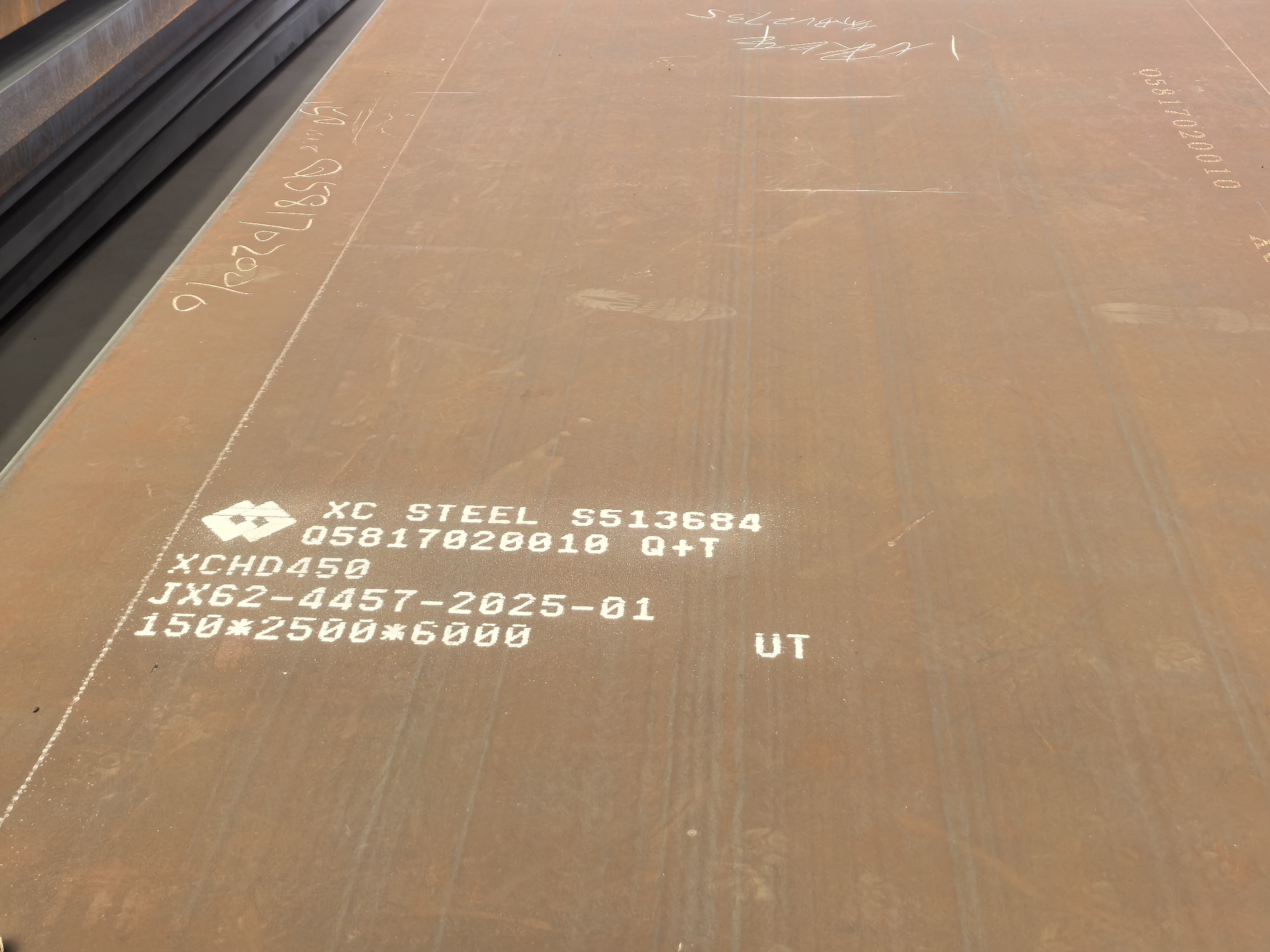
XCHD450 plate: exact grade designation and original MTC should be preserved in the order file.
Q550D, Q690D and Q960E high-strength plates
Q550D, Q690D and Q960E are high-strength structural plates used where load capacity, weight reduction and toughness matter. Q550D has a minimum yield strength of 550 MPa and is positioned for general heavy-load structures above -20 degrees C, balancing strength and cost. Q690D has a minimum yield strength of 690 MPa; the public reference cited in the supplied data gives GB/T 16270-2009 and tensile strength of 770 to 940 MPa for thickness up to 50 mm. Q690D and Q690E differ in impact temperature, with D associated with -20 degrees C and E with -40 degrees C. Q960E is described as combining high tensile strength with toughness at -40 degrees C.
Acceptance for these grades should focus on yield strength, tensile strength, impact toughness and the grade suffix, not on wear-plate HBW alone. A Q690D certificate should not be accepted as evidence for an NM500 wear application. If the part is a crane boom, port crane structure or other low-temperature structural member, the inspection and UT requirements in the application data should be written into the order as well.
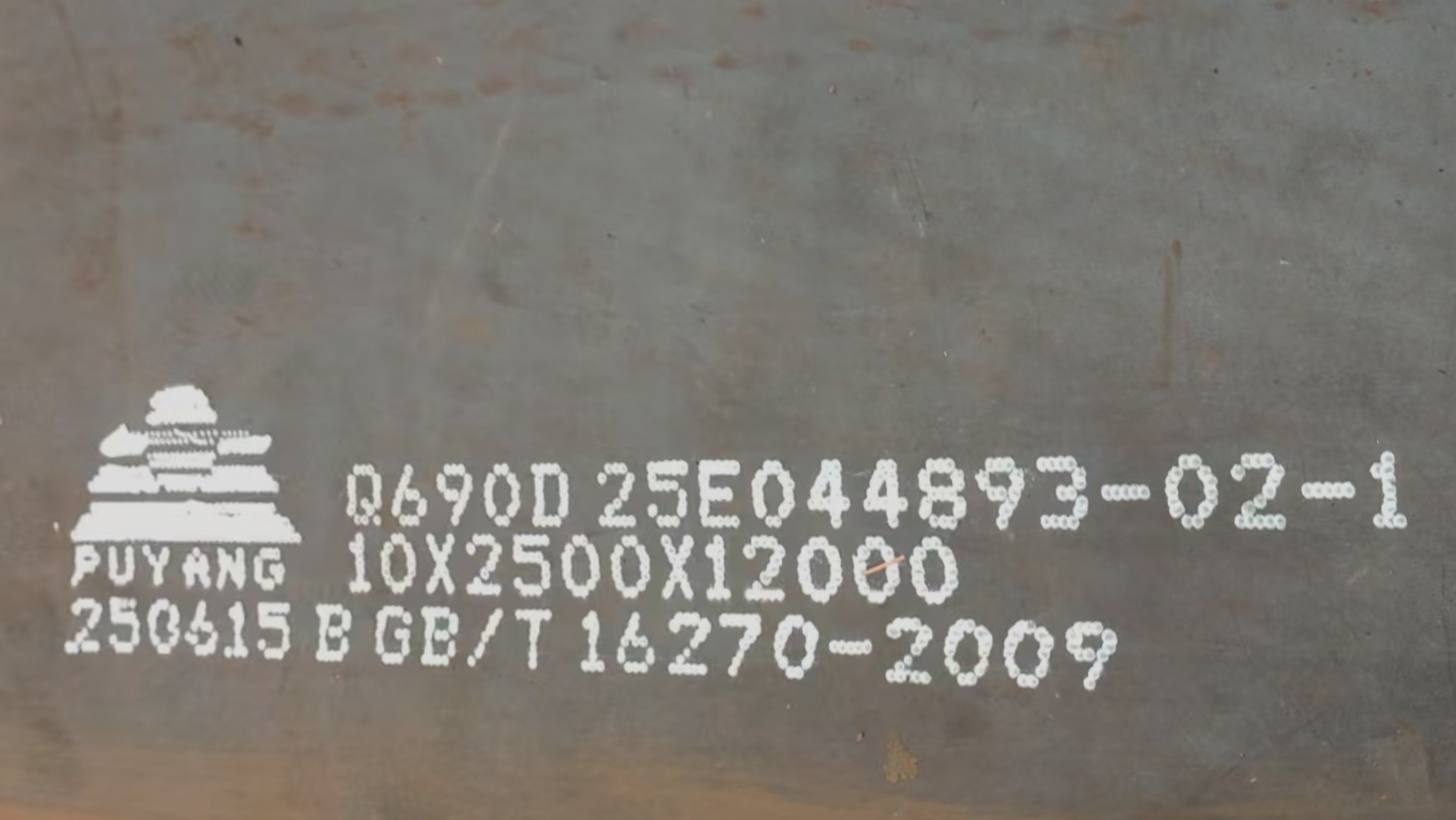
Q690D high-strength plate: acceptance should follow the structural grade requirements and MTC data.
Market language can be loose. Descriptions such as Hardox equivalent, AR400 type or NM400 equivalent should be converted into a named grade, a named mill and a defined acceptance test. An equivalence statement is not a test result, and it does not replace the original MTC.
| Grade | Documented role in supplied data | What to match on documents | Condition to record |
|---|---|---|---|
| NM400 | General wear plate for dump truck boxes, excavator buckets and hoppers; nominal 400 HBW | Exact grade, original MTC, agreed hardness result and method, dimensions | Do not accept an equivalent label as NM400; confirm the hardness band in the order |
| NM450 | Intermediate wear grade when NM400 wears too fast; supplier comparison states 12 to 15 percent higher service life in moderate-to-severe abrasion | Exact NM450 grade, MTC, dimensions, agreed fabrication requirements | Comparative service-life data is supplier data, not a site guarantee |
| NM500 | Heavy abrasive wear plate at 500 HBW; mining chutes, concrete mixers, scrapers | Exact NM500 grade, hardness result and method, MTC, dimensions | Higher cost and slightly poorer formability than lower grades; confirm fabrication |
| Mn13 | Work-hardening manganese steel for railway frogs, jaw crusher plates and shot blast liners | Mn13 grade, MTC, dimensions, impact application description | Not a quenched wear plate; surface hardens under impact, so do not require NM500-style delivery hardness |
| XCHD450 | Wear plate for medium-to-high wear; cold-formability and weldability; supplier states 15 to 20 percent longer wear life than NM400 under comparable conditions | Exact XCHD450 designation, original MTC, dimensions | Supplier comparative statement; do not use it as an automatic NM400 substitution |
| Q550D, Q690D, Q960E | High-strength structural plates; Q550D minimum yield 550 MPa; Q690D minimum yield 690 MPa; Q960E toughness at -40 degrees C | Grade suffix, yield, tensile, impact toughness, MTC, UT where specified | Not wear-plate HBW acceptance; do not treat as NM500 evidence |
Purchasing terms that turn checks into enforceable acceptance
A useful contract clause does not need to be long. It needs to remove the common escape routes. One practical structure is: the seller shall supply the named grade and mill; the seller shall provide an original MTC for each heat or plate identifying the producing mill, grade, dimensions and required test results; the grade, mill and dimensions on the MTC shall match the invoice, packing list and plate marking; no grade or mill substitution is permitted without the buyer's written approval before shipment; and the buyer may reject nonconforming documents or plates.
This clause should be adapted to the actual order and reviewed under the applicable contract law. It is a procurement control, not a legal ruling. The important point is that the same grade and mill fields appear in the purchase order, the MTC check and the receiving inspection. If the purchase order says NM400 but the MTC check focuses only on 400 HBW, the buyer has left a grade-substitution gap.
For customs, the commercial documents normally include an invoice, packing list and transport document, with a certificate of origin where applicable. The supplied trade reference cites HS 722540 for flat-rolled products of other alloy steel, width 600 mm or more, not further worked than hot-rolled. That is a reference point, not a binding classification. The importer should confirm the HS code, origin rules and any preferential treatment with a customs broker or the importing authority.
A practical acceptance workflow
- Before order: define the grade family, exact grade, dimensions, mill of origin, MTC fields, inspection scope and substitution rule. For a mining chute, this means deciding whether the liner needs NM400, NM450, NM500 or another grade based on abrasion and impact, then writing that choice into the order.
- Before production: confirm the mill, heat and certificate format. If third-party inspection or UT is required, confirm the procedure and timing before the plate is cut.
- Before shipment: review the draft or scanned MTC against the purchase order. Check mill name, grade, heat, dimensions and test results. Resolve discrepancies before booking or release.
- On receipt: match the physical marking, packing list, invoice and MTC. Check dimensions and surface condition. If hardness testing is agreed, follow the defined method and test location rather than testing a raw or heat-affected surface.
- Before fabrication: release the plate only when the document file is complete. Retain the MTC, cutting record and inspection report with the purchase order.
BGT's case data for a Russian mining equipment manufacturer covers 200 tons of plate for dump truck floor and side liners, with the application described as balanced toughness and wear resistance. That record shows application context. It does not replace the shipment-specific MTC, mill name or grade acceptance file.
Common documentation failures and how to close them
- Broad order wording. Wear plate or NM400 or equivalent leaves the supplier to decide what equivalence means. Close it by naming the exact grade and the applicable test.
- Trader-issued certificate. A certificate from the seller may not identify the producing mill. Close it by requiring an original MTC that names the mill of origin.
- Mill substitution. The MTC names a mill outside the approved list. Close it by requiring written approval before shipment and by rejecting unapproved substitutions.
- Hardness without method. A single HBW number without test location, grinding depth or load is weak evidence. Close it by writing the hardness method and acceptance band into the order.
- Cut-size mismatch. The MTC shows the mill plate size while the packing list shows cut pieces. Close it with a cutting record that links the delivered pieces to the original heat and plate.
- Equivalent grade acceptance. Hardox equivalent or AR400 type is treated as a grade. Close it by converting equivalence language into a named grade and a mill certificate.
- Q-grade accepted on hardness only. Q550D, Q690D and Q960E are structural grades with yield, tensile and impact requirements. Close it by checking the grade-specific mechanical data and suffix.
- Mn13 treated as a quenched plate. Mn13 work-hardens under impact and is not accepted by the same delivery-hardness logic as NM500. Close it by matching the application and the Mn13 MTC.
FAQ
Chinese wear resistant steel plate manufacturers for mining chutes
The mill-of-origin list in BGT Steel Plate's supplied product data includes Xingcheng, Nisco, Shandong Steel, Shougang, Xisc, Lianyuan, Puyang, Rongshen and Yongfeng. BGT supplies its listed wear plate products with an original MTC. For mining chutes, the supplied application data connects NM400, NM450 and NM500 with mining, hopper, chute and wear-liner uses; the exact mill, grade and MTC must be confirmed on the order. The mill list is a traceability reference, not a ranking or a certification of suitability for every chute.
Conclusion
Cross-border compliance for wear resistant steel plate is built from the purchase order outward. Define the exact grade family, grade, dimensions and mill of origin. Require an original MTC that names the producing mill and carries the heat, grade, dimensions and agreed test results. Match that certificate to the invoice, packing list and physical plate identification. For NM400 and NM500, check wear-grade hardness with its method; for Mn13, check the work-hardening application; for Q550D, Q690D and Q960E, check structural yield, tensile and impact data; for XCHD450, preserve the exact grade and supplier-stated comparison basis.
The mill list including Xingcheng, Nisco, Shandong Steel, Shougang, Xisc, Lianyuan, Puyang, Rongshen and Yongfeng is useful for traceability, but it is not a certification shortcut. Each shipment still needs its own document match, especially when plates are cut to size or supplied through a stockholder. A complete acceptance file is the practical evidence that the ordered wear plate, the producing mill and the delivered steel are the same material.
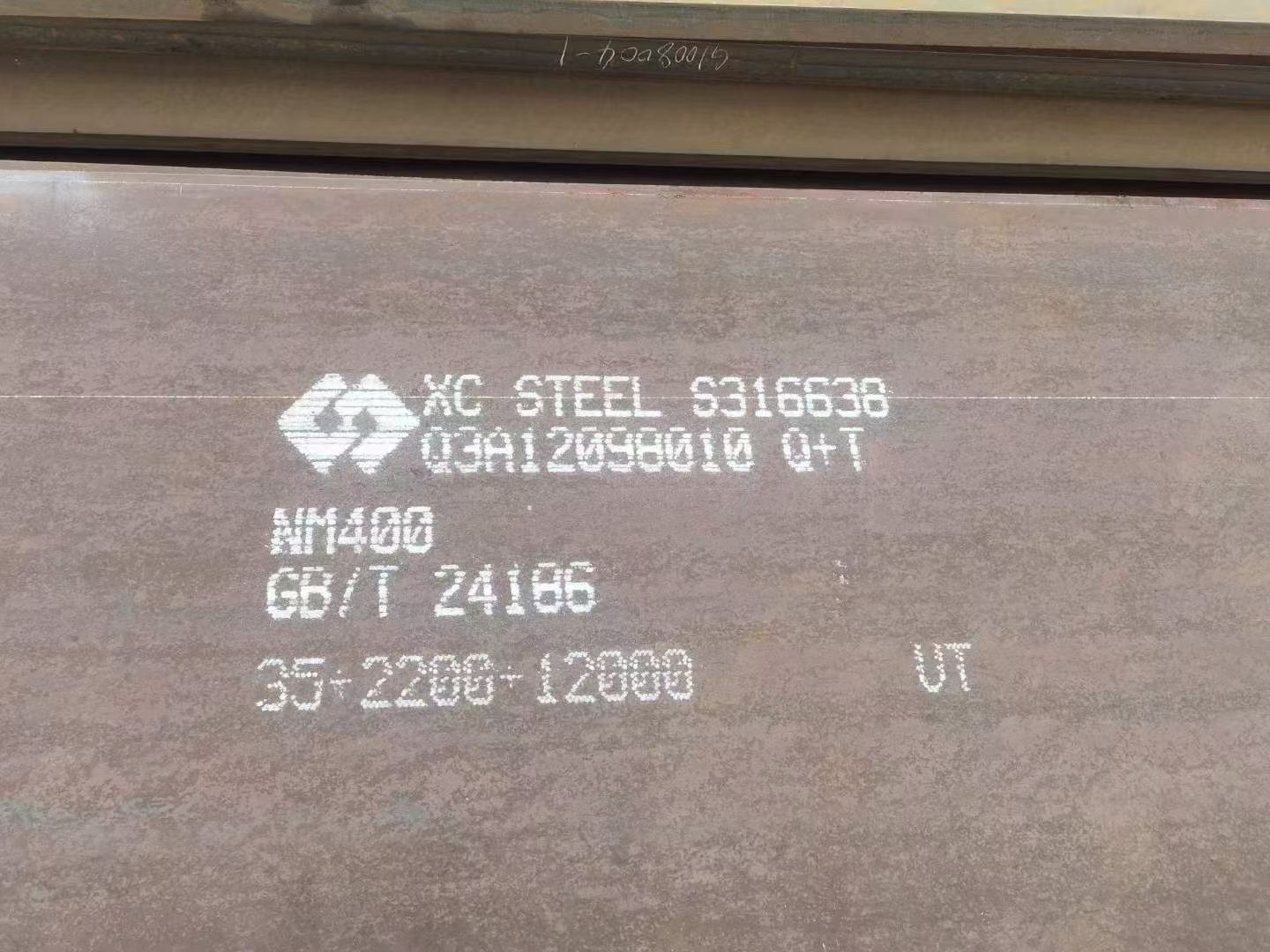
NM400 plate image: a sample or order review should still be supported by the original MTC and shipment documents.
BGT Steel Plate publishes its product catalogue for buyers who need to review grades and dimensions before an order: download the BGT Steel Plate catalogue. For a specific shipment, the catalogue does not replace the original MTC, mill name, grade designation or agreed inspection records.
Have Questions or Need More Details?
Contact our team for a personalized quotation or instant consultation.
Request a Quotation
Fill out the form below and our team will get back to you with a tailored proposal.
WhatsApp Direct Chat
Prefer to chat in real-time? Message us on WhatsApp for instant assistance & quick answers.
- Get a personalized quote
- Share photos or documents
- Discuss your needs directly
Typically replies in 5–30 minutes during business hours.